

Table of Contents
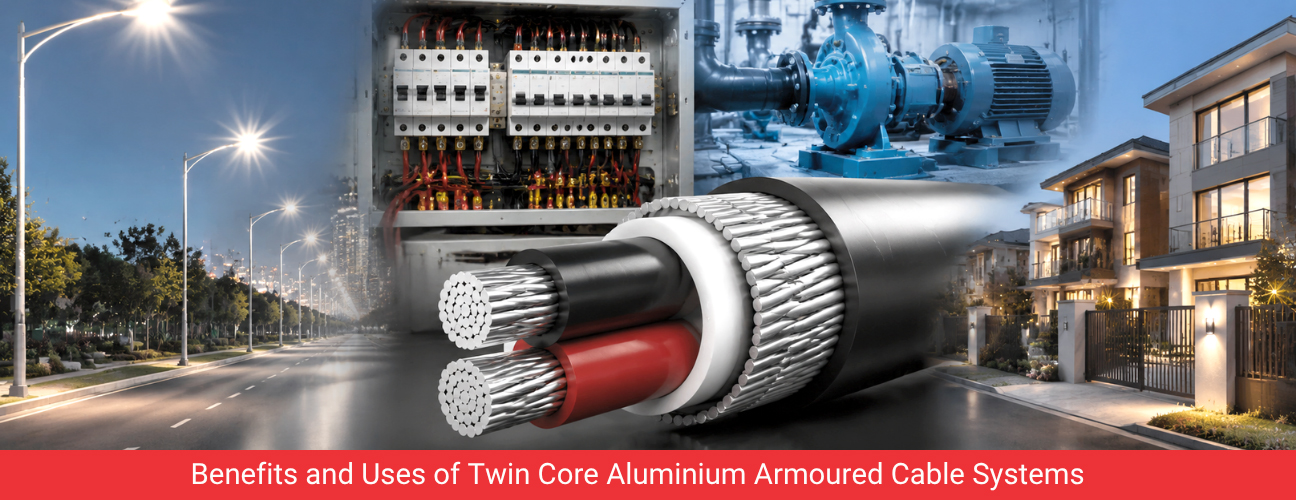
Twin core aluminium armoured cable, commonly called 2 core aluminium armoured cable, is one of the most frequently ordered configurations in the LT aluminium power cable range, used wherever a circuit carries a single phase supply rather than a full three phase load. This article covers where twin core aluminium armoured cable fits, the benefits it offers over alternative configurations, and the selection points buyers should check before finalising an order.
What 2 Core Aluminium Armoured Cable Carries
A twin core aluminium armoured cable contains two conductors, typically a phase and a neutral for single phase power circuits, though some control applications use twin core cable to carry two phases or two control signals. The armour layer, usually galvanised steel wire, provides mechanical protection for buried and tray mounted routes in the same way as it does on larger three and four core cables, while the smaller conductor count keeps the overall cable diameter compact.
Primary Applications of Twin Core Aluminium Armoured Cable
Application | Why Twin Core Aluminium Cable Fits |
Street lighting feeders | Single phase supply to lighting columns along a route, often with long cable runs where aluminium weight and cost advantages matter |
Single phase distribution boards | Feeders from a single phase source to a distribution board serving general power and lighting circuits |
Small motor and pump connections | Single phase motors up to a few kilowatts commonly connect through twin core feeders |
Residential and small commercial supply | Single phase service connections in buildings not requiring three phase power |
Signal and control wiring | Selected control applications using two conductors for a simple circuit |
Benefits of Choosing Twin Core Over Alternative Configurations
- Lower material cost than three or four core cable, since only two conductors are manufactured into the cable rather than three or four.
- Smaller overall cable diameter, which simplifies gland selection, tray space planning and bending radius requirements on site.
- Adequate for the actual electrical requirement of single phase circuits, avoiding the unnecessary cost of unused conductors that a three or four core cable would carry.
- Widely available across standard cross sections, from small residential feeder sizes through to larger street lighting and small industrial feeder sizes.
Sizing Considerations Specific to Twin Core Aluminium Cable
Sizing a twin core aluminium armoured cable follows the same general method as any LT power cable, full load current, derating for ambient temperature and grouping, voltage drop check and short circuit withstand verification, but with attention to the single phase voltage drop formula rather than the three phase version, since the factor of two for out and return current in a single phase circuit produces a different result than the three phase calculation for the same current and length.
Conductor Size (sq mm) | Typical Current Rating (A), Air Laid |
2.5 | 24 |
4 | 31 |
6 | 39 |
10 | 53 |
16 | 68 |
25 | 89 |
35 | 108 |
These values are indicative for reference during preliminary sizing, and final selection should always be confirmed against the manufacturer current rating table for the specific twin core aluminium armoured cable being purchased.
Point of Interest
Street lighting networks are one of the largest consumers of twin core aluminium armoured cable in India, since the long distances between lighting columns and the single phase nature of most lighting circuits make twin core cable both technically suitable and economically efficient compared with a three or four core alternative.
Common Cross Sections Ordered for Twin Core Applications
Buyers frequently search for specific twin core aluminium armoured cable sizes when placing orders, ranging from small 2.5 sq mm and 4 sq mm cables for light single phase loads through to larger 25 sq mm and 35 sq mm cables for longer street lighting feeders or higher current single phase connections. Confirming the correct size against the actual load current and run length, rather than ordering by habit or by what was used on a previous project, avoids both undersizing and unnecessary cost.
Testimonials
“Capital Cables delivered high-quality Twin Core Cables with excellent insulation and protection features. Their technical guidance made cable selection simple and effective.”
– Parth Joshi
Quality Checks for Twin Core Aluminium Armoured Cable Orders
- Confirm the conductor cross section matches the calculated requirement for the specific circuit, not a generic assumption carried over from another project.
- Check that armour construction and gauge suit the installation method, buried, tray mounted or duct routed.
- Request test certification for insulation resistance and conductor resistance for the specific batch supplied.
- Verify sheath type, PVC or FRLS, matches the fire safety requirement of the installation location.
Sourcing Twin Core Aluminium Armoured Cable
Capital Cables (India) Pvt. Ltd. supplies twin core aluminium armoured cable across the standard cross section range used for street lighting, single phase distribution and small motor connections, as an authorised dealer and distributor of leading Indian cable brands. The technical team supports buyers in confirming the correct size and construction for their specific single phase circuit before finalising an order, including guidance on standard drum lengths available for common project quantities.
Twin Core Cable Installation Practices for Outdoor Routes
Street lighting and outdoor distribution circuits using twin core aluminium armoured cable are typically buried direct in ground or routed through underground ducts, since these installations run alongside roads, footpaths and public areas where overhead cabling is often impractical or restricted by local authority requirements. Direct burial calls for adequate depth of cover, sand bedding and warning tape above the cable route to protect against future excavation damage, while duct routed installations need duct sizing that allows the cable to be pulled through without excessive friction or bending stress.
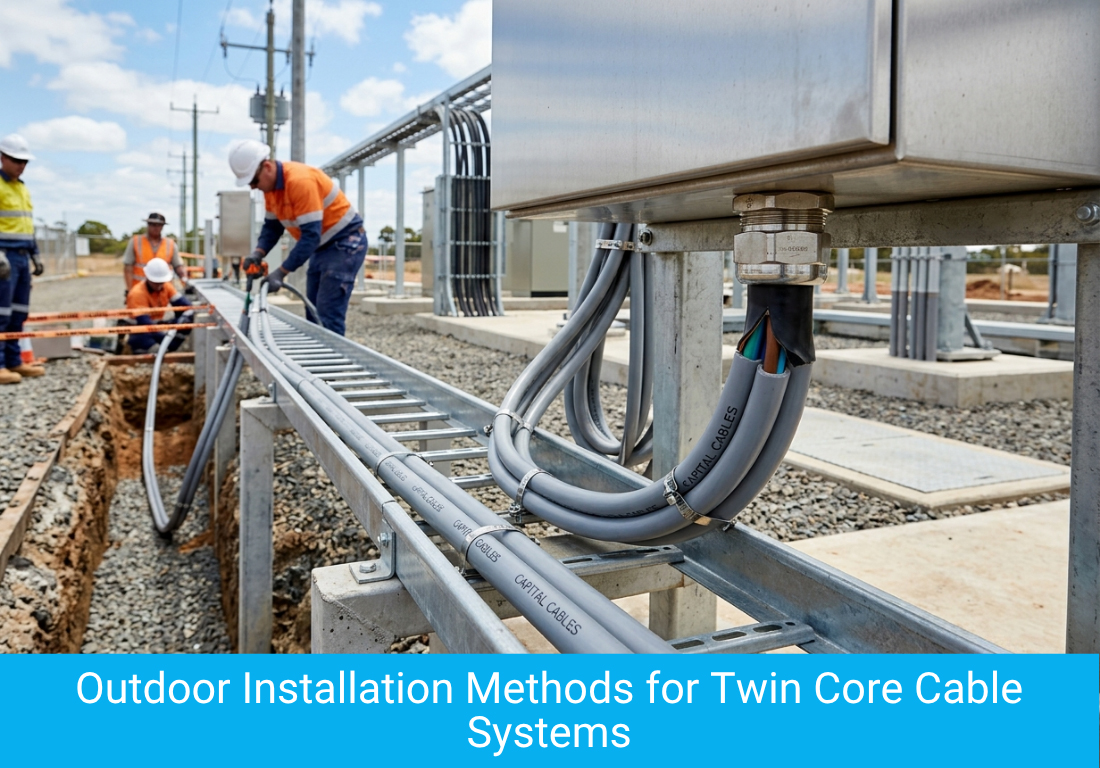
- Minimum burial depth typically follows local electrical authority guidelines, commonly around 750 millimetres for LT cable routes.
- Sand bedding above and below the cable protects the outer sheath from sharp stones and soil movement.
- Warning tape laid above the cable alerts future excavation work to the presence of a buried electrical cable.
- Route markers at regular intervals and at direction changes help maintenance teams locate the cable for future work.
Comparing Twin Core Aluminium Cable with Twin Core Copper Cable
For single phase circuits, buyers sometimes weigh twin core aluminium armoured cable against the copper equivalent, and the decision generally follows the same logic used for larger power cables. Aluminium offers a lower cost per metre and lighter installation weight, making it the default choice for long street lighting and outdoor distribution runs, while copper remains preferred for shorter runs feeding sensitive equipment where minimising voltage drop and connection resistance carries more weight than raw material cost.
Factor | Twin Core Aluminium Cable | Twin Core Copper Cable |
Material cost | Lower | Higher |
Weight per metre | Lighter | Heavier |
Conductivity | Lower, larger size needed for same rating | Higher, smaller size for same rating |
Typical use | Long outdoor runs, street lighting | Shorter runs, sensitive equipment feeders |
Maintenance Considerations for Buried Twin Core Feeders
Buried twin core aluminium armoured cable serving street lighting networks typically operates with minimal intervention for long periods, but periodic checks of lighting column supply points, armour earthing continuity and insulation resistance help identify a developing fault before it results in a section of lighting going dark. Municipal and facility maintenance teams commonly schedule these checks on an annual basis, alongside routine lighting column inspection, to keep the outdoor distribution network in reliable working condition.
Twin Core Cable Selection for Small Commercial and Residential Feeders
Beyond street lighting, twin core aluminium armoured cable serves as the standard feeder type for smaller commercial buildings and residential blocks with a single phase incoming supply, connecting the meter point to the main distribution board. In these applications, the current requirement is generally modest, and standard cross sections between 6 sq mm and 16 sq mm cover the majority of typical connection loads, with larger sizes reserved for bigger single phase installations or longer feeder runs where voltage drop pushes the required size upward.
Frequently Specified Twin Core Cable Sizes and Their Fit
Twin Core Size (sq mm) | Typical Fit |
4 | Small residential single phase feeders |
10 | Standard residential and small commercial connections |
16 | Larger residential blocks and small commercial feeders |
25 | Street lighting sections and larger single phase loads |
35 | Longer street lighting runs and higher current single phase feeders |
Buyers should always confirm the final size against a proper load and voltage drop calculation for their specific route length rather than selecting purely by comparison with a previous project, since run length and load current both vary from site to site.
Ordering and After Sales Support for Twin Core Cable Buyers
Beyond the initial supply of twin core aluminium armoured cable, buyers occasionally need support with technical queries that arise during or after installation, such as confirming the correct gland size for a given cable diameter or clarifying test certificate details for a completed project handover file. Working with an established supplier who can respond to these queries promptly reduces delays during commissioning and supports a smoother project closeout process.
For contractors managing multiple street lighting or distribution projects concurrently, having a single reliable point of contact for twin core cable supply, technical clarification and delivery scheduling reduces coordination overhead compared with managing separate relationships across several smaller suppliers for the same product category, and supports more predictable project timelines overall.
Table of Contents