


Table of Contents
One of the most common specification questions on LT power projects is whether to select 3 core or 4 core aluminium armoured cable for a given three phase circuit. The answer depends almost entirely on expected neutral current, and this guide sets out a clear method for making that decision on any project, along with the related question of when a 3.5 core cable offers a suitable middle option.
The Core Difference Between 3 Core and 4 Core Cable
A 3 core aluminium armoured cable carries only the three phase conductors, with no dedicated neutral conductor included in the cable. A 4 core aluminium armoured cable adds a fourth conductor, sized equal to the phase conductors, to carry neutral current. The construction difference is straightforward, but choosing between them requires understanding how much current the neutral of a specific circuit will actually carry in service.
When Neutral Current Is Genuinely Absent
Purely three phase loads, such as three phase induction motors, do not require a neutral connection at all, since the motor windings are connected in a balanced three phase configuration without a neutral point. For these circuits, 3 core aluminium armoured cable is the correct and most cost effective choice, since including a fourth conductor would add material cost without any functional benefit.
When Significant Neutral Current Should Be Expected
Circuits feeding a mix of single phase loads spread across the three phases, common in lighting distribution, general power sockets and IT equipment, can develop meaningful neutral current even when the connected load appears balanced on paper, because real world loads rarely stay perfectly balanced moment to moment. Non linear loads, such as computer power supplies, LED drivers and variable frequency drives, generate harmonic currents that add together in the neutral conductor rather than cancelling out, sometimes resulting in neutral current that exceeds the phase current. These circuits call for 4 core aluminium armoured cable with a full size neutral conductor.
The 3.5 Core Middle Ground Option
A 3.5 core aluminium armoured cable includes a neutral conductor sized smaller than the phase conductors, typically around half to two thirds the phase conductor cross section, offering a middle option for circuits expected to carry some neutral current but not enough to justify a full size fourth conductor. This configuration suits moderately unbalanced three phase distribution circuits where some single phase loading exists but non linear loads generating high harmonic neutral current are not a major factor.
Decision Table for Core Configuration Selection
Circuit Characteristic | Recommended Configuration |
Pure three phase motor load, no neutral required | 3 core aluminium armoured cable |
Balanced three phase distribution, light single phase loading | 3.5 core aluminium armoured cable |
Lighting and general power distribution, moderate imbalance | 4 core aluminium armoured cable |
Circuits with significant non linear or IT load | 4 core aluminium armoured cable with full size neutral |
Cost Difference Between 3 Core and 4 Core Aluminium Cable
A 4 core aluminium armoured cable costs more per metre than an equivalent 3 core cable, since it contains an additional full size conductor. On long cable runs, this cost difference can be significant across an entire project, which is why correctly assessing the actual neutral current requirement of each circuit, rather than defaulting to 4 core cable for every three phase feeder, supports both technical accuracy and project cost control.
Conductor Size (sq mm) | Relative Material Content, 3 Core | Relative Material Content, 4 Core |
16 | 3 conductors of 16 sq mm | 3 conductors of 16 sq mm plus 1 conductor of 16 sq mm |
35 | 3 conductors of 35 sq mm | 3 conductors of 35 sq mm plus 1 conductor of 35 sq mm |
70 | 3 conductors of 70 sq mm | 3 conductors of 70 sq mm plus 1 conductor of 70 sq mm |
Point of Interest
Technical guidance on neutral conductor sizing consistently notes that circuits feeding significant non linear loads, such as banks of LED lighting drivers or IT equipment, can see neutral current approach or exceed phase current due to triplen harmonic currents adding in the neutral rather than cancelling, which is a key reason full size neutral conductors remain standard practice for such circuits.
Practical Steps to Decide Between 3 Core and 4 Core Cable
- Identify whether the circuit feeds a purely three phase balanced load or a mix of single phase loads.
- Estimate the proportion of non linear load, such as LED lighting or electronic equipment, connected to the circuit.
- Select 3 core cable only where no neutral current is expected in service.
- Select 3.5 core cable for moderately balanced distribution circuits with limited single phase loading.
- Select 4 core cable with full size neutral for circuits with significant single phase or non linear load content.
- Confirm the final choice against the project electrical specification, which may mandate a specific configuration regardless of calculated neutral current.
Testimonials
“The Aluminium Armoured Cables supplied by Capital Cables offered excellent protection and stable power transmission for our project needs. Highly recommended for bulk electrical requirements.”
– Akash Modi
Sourcing 3 Core and 4 Core Aluminium Armoured Cable
Capital Cables (India) Pvt. Ltd. supplies 3 core, 3.5 core and 4 core aluminium armoured cable across the standard cross section range used on Indian projects, as an authorised dealer and distributor of leading Indian cable brands. The technical team helps consultants and contractors match the correct core configuration to the expected neutral current of each circuit, supporting both accurate design and efficient project cost.
How Electrical Codes Reference Neutral Conductor Sizing
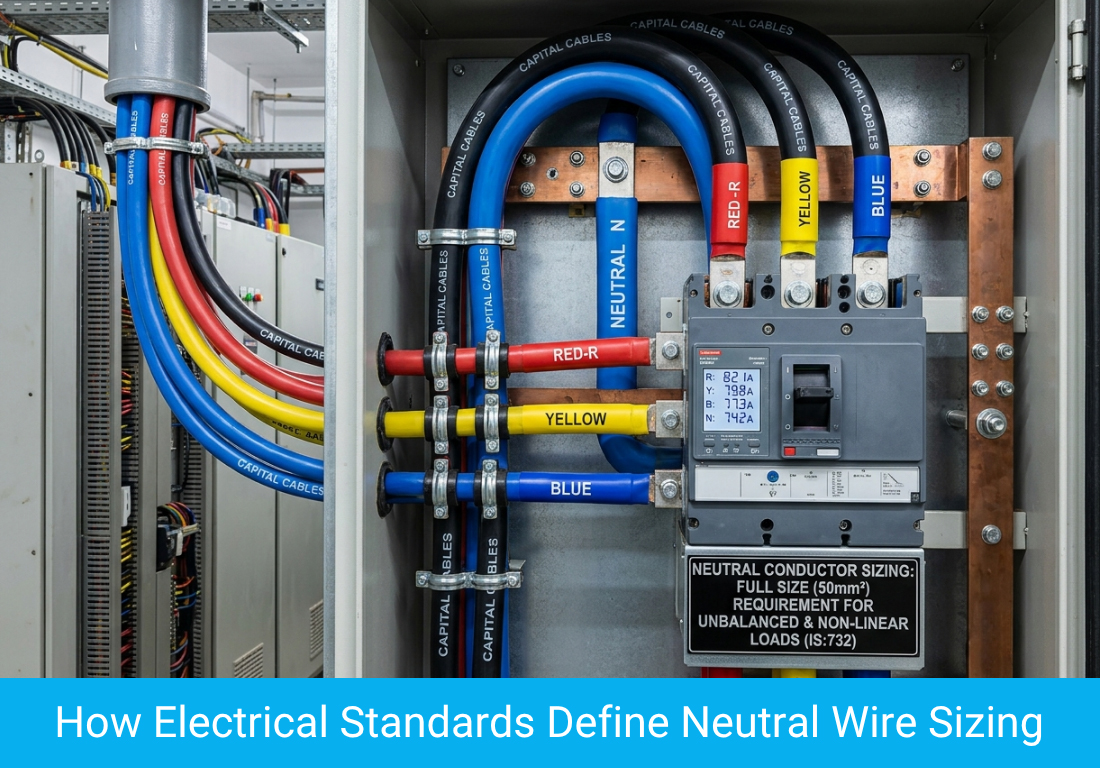
Indian electrical codes and standard engineering practice generally require the neutral conductor to be capable of carrying the maximum expected neutral current for the circuit, which is why simply defaulting to the smallest technically permissible neutral size is not good practice on circuits with meaningful non linear or unbalanced load content. Design guidance commonly recommends a full size neutral, equal to the phase conductor, wherever more than a modest proportion of the connected load is single phase or non linear, since undersizing the neutral risks overheating that a phase conductor of the same circuit would not experience under the same conditions.
Neutral Current Behaviour in Circuits with LED Lighting Loads
LED lighting drivers are a common source of harmonic current in modern buildings, and unlike a purely resistive load where neutral current from three balanced phases largely cancels out, harmonic currents at multiples of three times the fundamental frequency, known as triplen harmonics, add together in the neutral rather than cancelling. A distribution circuit feeding a large bank of LED fixtures across three phases can see neutral current approach or even exceed the current in any individual phase conductor, which is a primary reason four core cable with a full size neutral has become the default recommendation for modern lighting distribution circuits rather than the 3.5 core cable that was more common when incandescent and fluorescent lighting dominated building design.
Reviewing Existing 3 Core Installations for Upgrade Requirements
Facility owners upgrading lighting systems from older fluorescent fittings to LED, or adding significant IT and electronic equipment load to a building originally wired with 3 core or 3.5 core distribution cable, should review whether the existing neutral conductor remains adequate for the new load profile. In many cases, the phase conductors have ample spare capacity while the neutral conductor becomes the limiting factor after such an upgrade, making this a useful check during any lighting retrofit or major equipment addition project.
- Review the original core configuration and neutral conductor size against the updated connected load profile.
- Estimate the harmonic content introduced by new LED drivers or electronic equipment being added to the circuit.
- Consider replacing an undersized neutral cable section where the review indicates a genuine risk of neutral overheating.
- Document the review findings as part of the facility electrical maintenance record for future reference.
Specification Language for Core Configuration in Tender Documents
Project specifications and tender documents should state core configuration explicitly for each cable schedule entry rather than leaving it to a general note such as suitable core cable, since ambiguous specification language often results in contractors defaulting to whichever configuration is cheapest or most readily available, which may not match the actual neutral current requirement of the circuit. Clear specification of 3 core, 3.5 core or 4 core against each individual feeder in the cable schedule removes this ambiguity and ensures the installed cable matches the design intent.
This level of specification detail also simplifies procurement, since a supplier receiving a clear cable schedule with core configuration stated against each item can quote and deliver accurately without repeated clarification queries back to the design team during the tender or ordering stage.
Consultants preparing cable schedules for review by a client or a third party checking authority also benefit from this clarity, since an explicit core configuration against each feeder demonstrates that neutral current has been considered deliberately rather than left to chance during the design process.
Taken together, a clear method for deciding between 3 core, 3.5 core and 4 core aluminium armoured cable, combined with explicit specification language, supports both correct technical design and smooth procurement across any project scale, from a single building distribution board through to a large industrial facility with hundreds of individual feeders.
Table of Contents