

Table of Contents
India’s solar rooftop market has witnessed explosive growth, driven by falling module prices, government subsidies under the PM Surya Ghar Muft Bijli Yojana, and the commercial logic of generating cheaper power on-site. A typical 10 kWp rooftop system on an industrial or commercial building can generate 40–50 units per day, delivering payback in 4–6 years. But the quality of the electrical balance-of-system (BoS) — particularly the DC and AC cables — significantly affects system performance, safety, and longevity. Polycab LT power cables, supplied by authorised dealers like Capital Cables (I) Pvt. Ltd., are among the most specified cables for solar rooftop projects across Delhi, Noida, and Gurugram.
Understanding the Cable Architecture of a Rooftop Solar System
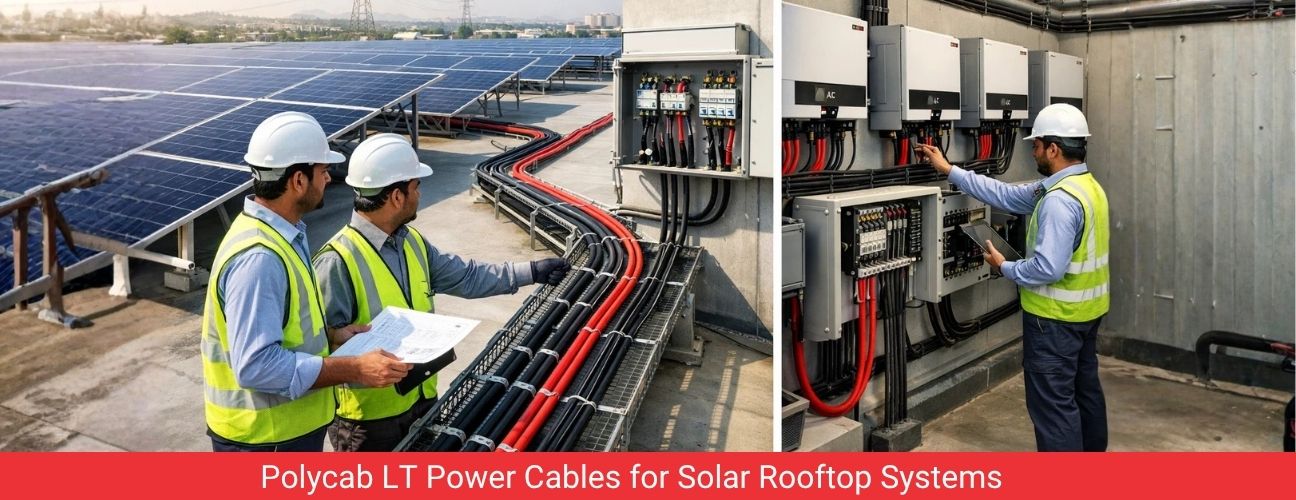
A grid-connected rooftop solar system has three distinct cable segments, each with different voltage, current, and environmental requirements:
- String DC Cables (Module to Junction Box / Combiner Box): These carry the high-voltage DC output of individual solar strings — typically 600–1000V DC. They are exposed to direct UV radiation, rain, extreme temperatures (rooftop surfaces can reach 80°C in summer), and must be rated for DC operation. Single-core XLPE-insulated, UV-stabilised solar DC cables with 600V or 1000V DC rating are mandatory here.
- DC Main Cables (Junction Box to Inverter): These carry the combined DC current from multiple strings to the inverter. For larger systems (>50 kWp), these cables may carry 100–300A DC and require careful sizing for voltage drop.
- AC Output Cables (Inverter to AC Distribution Panel / Meter): These carry single-phase or three-phase AC output from the inverter to the building’s LT distribution system. LT power cables — including Polycab’s 1.1 kV XLPE or PVC insulated cables — are standard for this segment.
 Email Us Now!
Why Polycab LT Power Cables for the AC Side
Polycab is India’s largest wire and cable manufacturer, with BIS-certified product ranges covering virtually every application. For the AC output side of solar rooftop systems, Polycab’s 1.1 kV LT power cables offer several advantages:
- XLPE Insulation: Superior thermal resistance (up to 90°C continuous, 250°C short circuit) compared to PVC, allowing higher current density and better performance in hot rooftop electrical rooms
- Polycab FRLSH Wires: For runs inside buildings, Polycab’s FRLSH (Flame Retardant Low Smoke Halogen-Free) cables reduce toxic fume emission in fire conditions — important for commercial and residential buildings
- Polycab Wire Price Competitiveness: As a large-scale manufacturer, Polycab offers consistent, competitive pricing through its authorised dealer network including Capital Cables, making project budgeting predictable
- Wide Range of Sizes: From 1.5 sq mm to 300 sq mm, Polycab’s range covers inverter output cables for systems from 1 kWp rooftop to multi-MW ground-mounted plants
- BIS Certification: All Polycab power cables carry ISI mark certification, essential for net metering applications approved by Delhi DISCOM, Noida Power, UPCL, and other utilities
How to Size LT Power Cables for Rooftop Solar AC Output
For the AC output cable from a solar inverter to the grid connection point, the following sizing methodology applies:
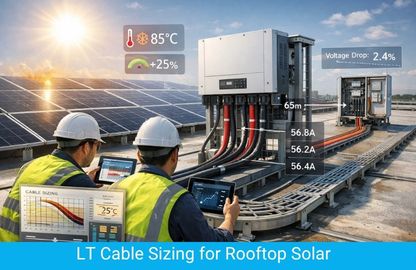
Step 1 — Determine Inverter Output Current: For a 10 kWp system with a 10 kVA three-phase inverter at 415V, FLA = 10,000 ÷ (1.732 × 415) = 13.9 A. For a 25 kWp system: ~34.8 A.
Step 2 — Apply Derating: Cables in conduit on a hot rooftop may need 0.87 (45°C) temperature derating. Add 25% safety margin for future capacity. Effective design current = FLA × 1.25 ÷ derating factor.
Step 3 — Check Voltage Drop: Inverter to distribution board runs of 20–50 metres are common. Keep voltage drop below 1.5% on the solar circuit for optimal MPPT performance.
Step 4 — Select Cable Size: For most residential and small commercial rooftop systems (5–25 kWp), 4 sq mm to 10 sq mm three-core Polycab XLPE cable is adequate for the inverter AC output. Larger systems (50–100 kWp) typically require 25–50 sq mm four-core cables.
DC String Cable Selection Tips
For the DC side of the solar installation, standard LT power cables are not appropriate. The following specifications are required:
- DC Voltage Rating: Minimum 600V DC or 1000V DC depending on inverter string voltage
- UV Resistance: The outer sheath must be UV-stabilised to withstand 25 years of rooftop UV exposure
- Temperature Rating: Minimum 90°C continuous rating, capable of handling rooftop surface temperatures
- Tinned Copper Conductors: Preferred for DC solar cables to resist oxidation and ensure long-term low-resistance connections
- Single Core: Always use single-core cables for DC strings to allow individual positive and negative routing
Polycab manufactures dedicated solar DC cables meeting IEC 62930 standard, available through Capital Cables for Delhi-NCR projects.
Cable Routing and Installation Best Practices for Solar Rooftop
- Use UV-resistant conduit or cable trays for all DC cable runs on the rooftop to provide mechanical protection and organised routing
- Segregate DC cables from AC cables — run them in separate conduits or maintain 150mm minimum separation on shared trays
- Avoid cable loops on rooftops that can collect water — route cables with a slight slope towards conduit entry points
- Use MC4 connectors rated for the full string voltage and current for DC string connections — do not use generic connectors
- All penetrations through waterproofing membranes must use approved solar cable glands to prevent water ingress
- Label all DC and AC cables clearly at both ends with string number, polarity (for DC), and circuit identification
- Use fire-resistant conduit or Polycab FRLSH cables inside the building from the inverter to the distribution panel
- Earth all cable trays, inverter enclosures, and module frames with copper earthing conductors to prevent touch voltage hazards
Testimonials
“Good”
Common Wiring Errors in Solar Rooftop Installations
- Using standard PVC house wires for DC string cables — these are not rated for DC voltage or UV exposure and will fail within 2–3 years
- Undersizing AC output cables to save cost — a 1V extra drop at the inverter AC terminal causes the inverter to reduce output, costing energy generation over 25 years
- Sharing neutral conductors between solar inverter output and other loads without proper coordination — can cause protection relay issues with DISCOM metering
- Not providing a lockable DC isolator between string combiner and inverter — mandatory under IS 16221 for rooftop solar installations
- Using non-ISI marked cables that fail DISCOM inspection and require costly replacement before grid connection approval
Capital Cables as Your Solar Project Cable Partner
Capital Cables (I) Pvt. Ltd. is an authorised distributor for Polycab wires and cables in Delhi-NCR, stocking the full range of Polycab LT power cables, XLPE cables, FRLSH wires, and solar DC cables. For solar rooftop developers, EPCs, and electrical contractors, Capital Cables offers:
- Project-specific cable scheduling and quantity take-off support
- Genuine Polycab products with manufacturer warranty and BIS certification
- Competitive Polycab wire prices with volume discount for solar project orders
- Delivery to project sites across Delhi, Noida, Gurugram, Faridabad, and Ghaziabad
- Technical guidance on cable specification for DISCOM net metering approval
Conclusion
A well-designed solar rooftop system starts with the right cables. Polycab LT power cables — backed by BIS certification, XLPE insulation technology, and a proven track record across thousands of installations — are the go-to choice for AC-side solar wiring in India. Pairing quality cables with proper sizing calculations, correct installation practices, and sourcing from authorised dealers like Capital Cables (I) Pvt. Ltd. ensures your solar installation delivers optimum yield, compliance, and a 25-year trouble-free operational life.
Table of Contents