

Table of Contents
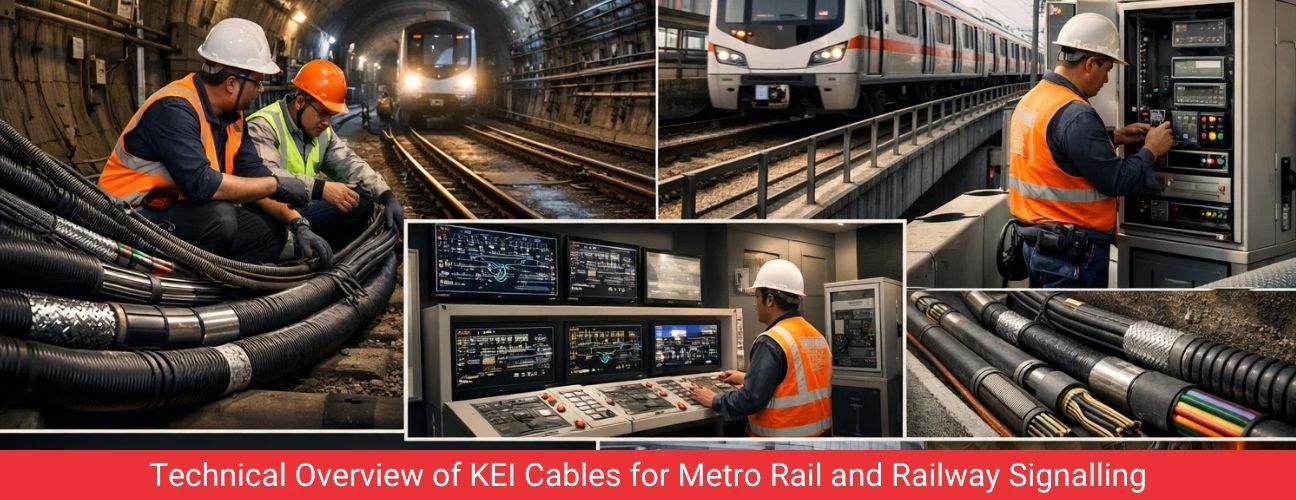
India’s urban mobility revolution is being driven by rapid metro rail expansion — Delhi Metro’s network has crossed 390 km, and cities including Mumbai, Bangalore, Hyderabad, Chennai, Pune, and Ahmedabad are executing major metro projects. Simultaneously, Indian Railways is undertaking the largest modernisation programme in its history — including the Kavach anti-collision system, automatic block signalling, and high-speed rail corridors. At the heart of both metro and railway electrical infrastructure lies a specialised and demanding cable requirement. KEI Industries, one of India’s leading cable manufacturers, supplies a comprehensive range of cables certified for railway and metro applications. Capital Cables (I) Pvt. Ltd. is an authorised KEI distributor serving contractors and system integrators in Delhi-NCR.
Why Railway and Metro Applications Require Specialised Cables
Standard industrial cables — even those meeting IS 1554 or IS 7098 — are not always adequate for railway and metro environments. The specific challenges include:
- Electromagnetic Interference (EMI): Railway traction systems generate intense electromagnetic fields. Signal and communication cables must be heavily shielded to prevent data corruption in signalling circuits.
- Vibration and Mechanical Stress: Trackside cables and cables inside rolling stock experience continuous vibration. Cables must have robust armour and flexible cores to withstand mechanical fatigue.
- Fire Safety in Tunnels: Metro tunnels present extreme fire risk. Low smoke halogen-free (LSZH/ZHFR) or fire survival cables are mandatory under DMRC (Delhi Metro Rail Corporation) and CMRS (Commissioner of Metro Rail Safety) specifications.
- Wide Temperature Range: Outdoor trackside cables in North India experience temperatures from -5°C in winter to 55°C in summer. Cable insulation must maintain performance across this range.
- DC Traction Stray Current Corrosion: 750V DC third-rail or 25 kV AC overhead traction systems create stray currents in metallic cable sheaths and armour. Cables must have robust corrosion protection.
- Long Service Life: Metro and railway infrastructure is designed for 30–50 year operational lives. Cables must demonstrate accelerated ageing test compliance to confirm long-term performance.
KEI Cable Range for Metro Rail Applications
KEI Industries supplies cables across all major metro rail application categories:
Power Cables (Traction Substations and Auxiliary Power):
- 33 kV and 66 kV HT XLPE cables for grid power intake at traction substations
- 1 kV LT XLPE four-core copper armoured cables for auxiliary power distribution within stations
- Fire survival cables (BS 6387 CWZ rated) for emergency circuits, evacuation lighting, and fire pump feeders
Signalling and Control Cables:
- Multicore screened instrumentation cables (IS 1554 Part 1) for signal interface between trackside equipment and control centres
- FRLS control cables for interlocking panels, axle counters, and track circuit equipment
- Armoured signalling cables for direct burial alongside track
Communication and Telecom Cables:
- Jelly-filled telephone cables for trackside communication systems
- Coaxial cables for CCTV, public address system, and Passenger Information System (PIS) backbone networks
- Optical fibre cables for SCADA, ATP (Automatic Train Protection), and Train Management System data transmission
KEI Cables for Railway Signalling: Technical Specifications
Railway signalling is a safety-critical application — a cable failure in a signal circuit can lead to signal failures and potential collision risk. Indian Railways’ RDSO (Research Designs and Standards Organisation) specifies detailed cable requirements for signalling applications. KEI’s signalling cable range meets RDSO specifications:
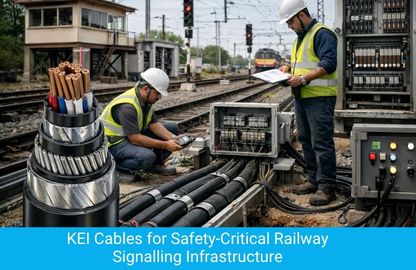
- Conductor: Stranded annealed copper (Class 2 per IS 8130)
- Insulation: PVC Type C (IS 5831) or FRLS compound
- Screen: Aluminium/polyester foil with drain wire — provides >90% coverage for EMI shielding
- Inner Sheath: PVC or FRLS
- Armour: Steel wire armour (SWA) per IS 3975 for buried and mechanical protection cables
- Outer Sheath: FRLS PVC — essential in tunnels and station buildings
- Voltage Rating: 650V/1100V for most signalling cables
- Number of Cores: 2 to 61 cores depending on application
- Core Identification: Colour coded per IS 1554 or numbered
FRLS and LSZH Requirements in Metro Tunnels
DMRC and all major metro operators in India mandate LSZH (Low Smoke Zero Halogen) or FRLS (Flame Retardant Low Smoke) cables for all applications inside metro tunnels, stations, and rolling stock. The rationale:
- In a tunnel fire, standard PVC cables generate dense, toxic chlorinated smoke that is lethal within minutes and severely impedes evacuation and emergency response
- LSZH cables, when burning, produce minimal smoke and no halogen acids (no HCl gas), dramatically improving survivability in confined spaces
- FRLS cables achieve a balance between fire retardancy, mechanical performance, and cost — suitable for station buildings and above-ground installations where smoke dilution is possible
KEI manufactures both LSZH and FRLS variants of its power, control, and signalling cables. These cables undergo the oxygen index test (>30%), smoke density test (Ds max <100), and acid gas test (<0.5% HCl) as required by DMRC cable specifications.
Testimonials
Guys it’s really good quality of cables…..
I am also using. So why are you wating
Order Now………
EMI Shielding in Railway Signalling Cables
Railway trackside environments are among the most electrically noisy in the world. The 25 kV AC overhead traction system, traction return currents in rails, and thyristor-controlled traction drives on modern rolling stock generate broadband electromagnetic interference from 50 Hz to several kHz.
KEI’s screened signalling cables use:
- Aluminium-Polyester (Al-PET) Foil Screen: Provides excellent coverage at frequencies above 1 MHz — effective against the high-frequency components of traction drive harmonics
- Tinned Copper Drain Wire: Provides a low-resistance earth path for the screen and ensures continuity of screening effectiveness
- Overall Steel Wire Armour (SWA): Provides a secondary magnetic shield against low-frequency (50 Hz/150 Hz) interference from traction return currents
For applications with extremely high EMI levels — near traction substations, in signal equipment rooms adjacent to inverter drives — KEI also offers cables with double screening (individual pair screens plus overall screen) meeting EN 50288 standards.
Trackside Cable Installation Standards for Indian Railways
RDSO specification No. IRS: TC-30 governs the installation of cables in Indian Railways signalling and telecommunications. Key requirements:
- All cables crossing tracks must be in RCC pipe culverts — direct burial cables must not be used for track crossings
- Minimum burial depth for direct-buried trackside signal cables: 750 mm below formation level
- All cable joints in buried runs must use approved resin-filled junction boxes — no field-made tape joints
- Cable routes must be documented with route markers at maximum 30 m intervals
- All cable ends must be sealed with heat-shrink cable end caps to prevent moisture ingress
- Armoured cables must be properly earthed at both ends via cable glands and copper earth conductors
KEI Cables in Delhi Metro and Other Urban Rail Projects
KEI Industries has supplied cables to multiple metro rail projects in India, including phases of the Delhi Metro. Their DMRC-approved cable range covers the complete system from 33 kV HT power intake to trackside signalling and communication cables.
For Delhi Metro’s ongoing Phase IV expansion — covering corridors from Janakpuri West to RK Ashram, Aerocity to Tughlakabad, and other alignments — KEI cables conforming to DMRC’s current technical specifications are being specified by system integrators and civil contractors.
Capital Cables (I) Pvt. Ltd., as an authorised KEI distributor in Delhi-NCR, can supply KEI cables for metro and railway projects including:
- LT power cables for station auxiliary power distribution
- FRLS and LSZH control cables for station electrical rooms
- Screened instrumentation cables for signal equipment
- Fire survival cables for emergency circuits
Jelly-filled telecom cables for station communication systems
How Capital Cables Supports Metro and Railway Contractors
Large infrastructure projects like metro rail involve complex procurement — multiple cable types, tight delivery schedules, DMRC inspection requirements, and extensive documentation. Capital Cables (I) Pvt. Ltd. provides:
- KEI cables conforming to DMRC, RDSO, and IRS technical specifications
- Third-party test certificates and manufacturer test reports on request
- Batch traceability documentation for quality assurance audits
- Competitive pricing for large-volume project orders
- Project-specific delivery scheduling to match construction milestones
- Technical support for cable specification review and compliance verification
Conclusion
Metro rail and railway signalling applications set the highest bar for cable performance — combining fire safety, EMI immunity, mechanical robustness, long service life, and compliance with RDSO and metro authority specifications. KEI Industries, with its comprehensive range of FRLS, LSZH, screened, armoured, and fire survival cables, is one of the few Indian manufacturers capable of meeting this demanding brief. Capital Cables (I) Pvt. Ltd., as KEI’s authorised distributor in Delhi, is the preferred supply partner for contractors and system integrators working on metro rail and railway modernisation projects across the National Capital Region.
Table of Contents