

Table of Contents
Understanding Copper Armoured Cable Construction and Current Rating Requirements
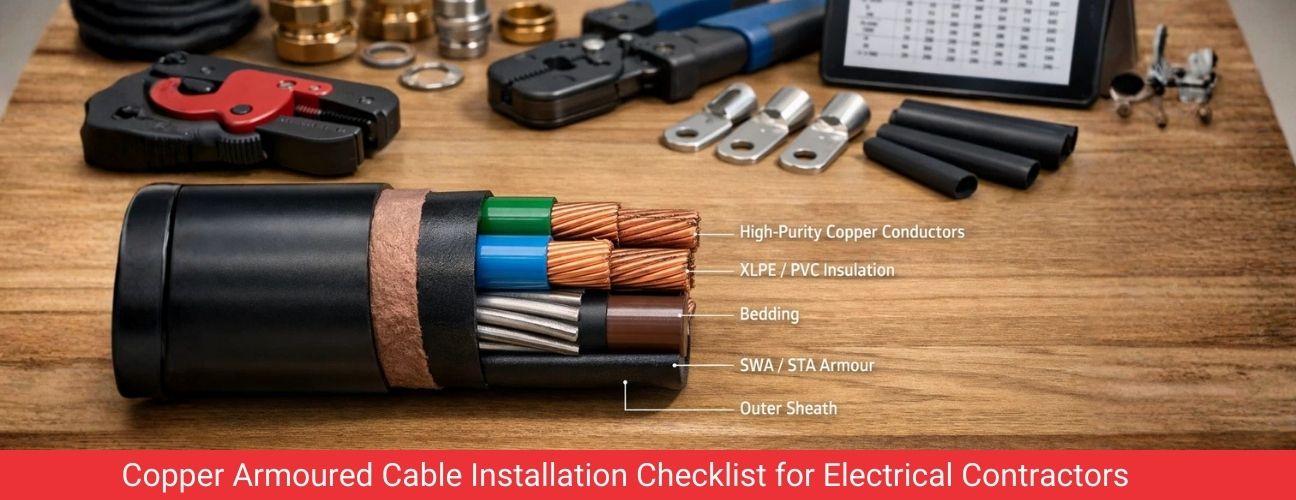
A copper armoured cable is a multi-layered assembly designed for “install and forget” reliability. It typically consists of high-purity copper conductors, XLPE or PVC insulation, a bedding layer, and a layer of Steel Wire Armour (SWA) or Steel Tape Armour (STA). The current rating is not a fixed number; it is heavily influenced by the construction materials, as XLPE-insulated cables can safely operate at higher temperatures (90°C) compared to PVC (70°C).
Selecting the Right Copper Armoured Cable Size Based on Load and Application
Choosing the correct copper armoured cable size involves more than matching the breaker amps. Contractors must calculate voltage drop over long distances and account for “grouping factors” where multiple cables are run in the same tray. Utilizing a current carrying capacity chart is essential to ensure the cable doesn’t overheat under peak load.
 Drop Us an Email!
Pre-Installation Inspection Checklist for Copper Armoured Cables
Before the cable is pulled, verify the following:
- Standard Compliance: Ensure the cable is embossed with the relevant IS (Indian Standards) or IEC (International Electrotechnical Commission) markings.
- Physical Integrity: Inspect the outer sheath for “flat spots” or punctures that might have occurred during transit.
- Continuity Check: Perform a preliminary insulation resistance (IR) test while the cable is still on the drum.
Safe Handling, Storage, and Drum Unloading of Copper Armoured Cables
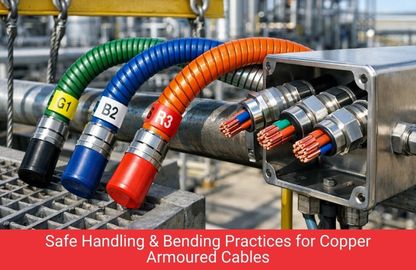
Copper is heavy. Improper unloading can lead to “kinking,” which permanently damages the internal conductors.
- Always use a spreader bar when lifting with a crane.
- Never drop a drum from a truck bed, even onto old tires.
- Store drums on their flanges and ensure the cable ends are sealed with heat-shrink caps to prevent moisture “wicking.”
Recommended Bending Radius and Routing Practices for Copper Armoured Cables
To maintain the integrity of the armouring and insulation, contractors must respect the minimum bending radius.
- Rule of Thumb: For copper SWA cables, the bending radius is typically 12 to 15 times the overall diameter (OD).
- Use specialized cable rollers for routing to prevent the sheath from scraping against tray edges or duct entries.
Installation Guidelines for Copper Armoured Cables in Underground and Duct Systems
When installing in underground duct systems, the “pulling tension” must be monitored.
- Use a cable socks/grip attached to the armouring or the conductor depending on the tension required.
- For direct burial, ensure a “snaking” pattern to allow for ground movement and thermal expansion.
Our Other Product
PVC Insulated Winding Wire & 3 Core Flat CablesProper Glanding, Termination, and Earthing of Copper Armoured Cables
The termination point is where most faults occur.
- Glanding: Use the correct size of brass BW (indoor) or CW (outdoor/weatherproof) glands. The gland must grip the armouring firmly to ensure electrical continuity.
- Earthing: The steel armouring often serves as the Circuit Protective Conductor (CPC). Ensure it is bonded to the main earth terminal using an earth tag (banjo) and a proper lug.
Testimonials
“Good”
Current Carrying Capacity Considerations in Direct Ground, Duct, and Air Installations
The environment dictates the heat dissipation rate:
- In Air: Highest dissipation, but susceptible to ambient temperature spikes.
- Direct Ground: Good dissipation, but requires derating based on soil thermal resistivity.
- In Duct: Poorer dissipation; cables must be significantly derated to prevent insulation melting.
Compliance with IS and IEC Standards for Copper Armoured Cable Installation
Adhering to IS 7098 (for XLPE) or IS 1554 (for PVC) ensures legal and insurance compliance. These standards dictate everything from the thickness of the insulation to the galvanized coating of the steel armour.
Testing, Commissioning, and Common Installation Mistakes to Avoid
Final commissioning should include:
- High-Pot (High Potential) Testing: To detect weak spots in insulation.
- Earth Loop Impedance Test: To ensure the armouring provides a safe path for fault current.
- Common Mistakes: Avoid using oversized glands, skipping the bi-metallic paste when connecting to aluminium busbars, and failing to support vertical cable runs with proper cleats.
Conclusion: Ensuring Electrical Excellence
A successful copper armoured cable installation is measured by its invisibility—it should perform its duty for decades without intervention. For the professional electrical contractor, following a structured checklist is not just about technical compliance; it is about risk management and reputation.
By meticulously calculating the current carrying capacity, respecting the bending radius, and ensuring robust earthing and glanding, you protect the infrastructure from the two greatest threats to electrical systems: heat and moisture. As energy demands grow and systems become more complex, the fundamental principles of proper cable management remain the most effective tool in a contractor’s arsenal.
Table of Contents