

Table of Contents
In the demanding sectors of industrial infrastructure and power distribution, aluminium armoured cables have emerged as the backbone of modern electrical grids. Offering a strategic balance between high conductivity and lightweight durability, these cables are indispensable for both power and control applications. However, the performance of an Aluminium Armoured Cable is only as reliable as its installation.
When deployed in “Harsh Environments”—ranging from high-salinity coastal zones and chemical processing plants to deep underground burials—standard procedures are often insufficient. Environmental stressors such as moisture ingress, chemical corrosion, and mechanical impact can compromise the lifespan of even the most robust 11kV aluminium four-core systems. This article outlines the essential best practices for handling, laying, and terminating aluminium cables, ensuring that your project remains safe, compliant, and cost-effective from the initial pull to the final connection.
Selecting the Right Aluminium Armoured Cable for Harsh Environmental Conditions
Not all environments are created equal. Choosing the correct cable involves assessing the specific “harshness” of your site. For high-moisture or saline environments, an Aluminium Armoured Cable with a specialized PVC or LSZH (Low Smoke Zero Halogen) outer sheath is essential to prevent corrosion. When dealing with high-voltage requirements, an 11kV aluminium four-core cable provides the robust insulation needed to withstand electrical stress alongside environmental challenges.
Understanding Aluminium Armoured Cable Construction for Mechanical and Environmental Protection
The strength of these cables lies in their multi-layered construction:
- Conductor: High-conductivity aluminium.
- Insulation: Typically XLPE (Cross-linked Polyethylene), which offers superior thermal resistance.
- Armouring: A layer of Galvanized Steel Wire (GSW) or Steel Tape that provides mechanical protection against crushing and rodent attacks.
- Outer Sheath: The final barrier against chemicals, UV radiation, and moisture.
Pre-Installation Checks for Aluminium Armoured Cables in Industrial and Outdoor Applications
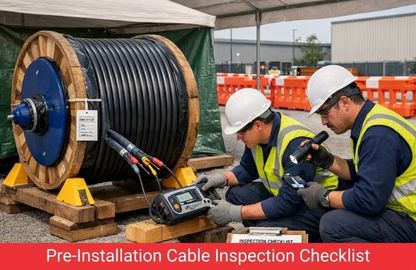
Before laying a single meter, perform these critical checks:
- Continuity and Insulation Test: Use a Megger to ensure the cable has not been damaged during transit.
- Visual Inspection: Check for any nicks or deep scratches in the outer sheath that could allow moisture ingress.
- Drum Inspection: Ensure the cable drum is undamaged and the seals on the cable ends (end caps) are intact.
Proper Handling and Storage of Aluminium Armoured Cables at Project Sites
Improper storage can lead to premature failure. Cable drums should always be stored upright and on a firm, well-drained surface. Never lay drums flat on their sides (“on the flange”). When moving the cable, use a spindle and a proper trailer to avoid dragging the aluminium armoured cable across sharp rocks or debris, which can compromise the protective outer jacket.
Read Our Article
Choosing the Right Aluminium Armoured Cable: A Comprehensive GuideBest Practices for Laying Aluminium Armoured Cables in Underground and Direct Burial Installations
For direct burial, the trench must be free of sharp stones.
- Bedding: Lay a 75mm to 100mm bed of sifted sand or stone dust before placing the cable.
- Covering: Once the cable is laid, cover it with another layer of sand before placing cable protection tiles or warning tapes.
- Depth: Follow local regulations, typically a minimum depth of 600mm for low voltage and 900mm+ for high-voltage lines like 11kV aluminium four-core systems.
Installing 2 Core Aluminium Armoured Cables for Power and Control Applications
For smaller applications, a 2 core aluminium armoured cable is frequently used for single-phase power supply or control signals. Despite being smaller, these require the same level of care in glanding and termination as larger power cables to prevent oxidation at the contact points.
Client Speaks
Guys it’s really good quality of cables…..
I am also using. So why are you wating🧐
Order Now………
Safe Bending Radius and Routing Guidelines for Aluminium Armoured Cables
One of the most common causes of cable failure is exceeding the bending radius. Bending the cable too sharply damages the insulation and the internal arrangement of the armouring.
- Standard Rule: For armoured cables, the minimum bending radius is generally 12x to 15x the overall diameter of the cable.
Always use rollers at every corner during the pulling process to maintain a smooth flow.
Our Other Product
LT XLPE Cables (Unarmoured/Armoured)Termination, Glanding, and Earthing Techniques for Aluminium Armoured Cables
Termination is the most “at-risk” part of the installation.
- Bi-metallic Lugs: Since aluminium reacts with copper terminals, always use bi-metallic lugs to prevent galvanic corrosion.
- Proper Glanding: Use IP66 or IP68 rated brass or nickel-plated glands to ensure the entry point is sealed against the harsh environment.
- Earthing: The armour should be effectively earthed at the supply end to provide a low-resistance path for fault currents.
Installation Considerations for Different Sizes (2.5 sq mm to 630 sq mm)
The size of the cable significantly impacts handling:
- Small Sizes (2.5 sq mm to 6 sq mm): Popular for lighting and small machinery. Even for these, checking the 2.5 sq mm 2 core aluminium cable price vs. quality is vital; cheaper, non-standard cables often have brittle armouring.
- Mid Sizes (25 sq mm to 35 sq mm): Requires mechanical pullers if the run is long.
- Large Sizes (Up to 630 sq mm): Requires heavy-duty winches and specialized termination kits.
Cable Type/Size | Primary Use Case | Key Installation Note |
4 sq mm 2 core | Residential/Small Industrial | Ensure tight glanding to avoid moisture. |
6 sq mm 2 core | Industrial lighting/Small pumps | Check for bi-metallic contact at terminals. |
11kV Four-Core | Main Power Distribution | Requires specialized high-voltage termination kits. |
Common Installation Mistakes to Avoid in Harsh Environments
- Leaving Ends Exposed: Failing to re-cap a cut cable allows moisture to “wick” up the strands, ruining the cable from the inside out.
- Incorrect Lug Crimping: Using the wrong die size for aluminium lugs leads to hotspots and eventual fire hazards.
- Ignoring the 2 core aluminium cable price list trap: Selecting the cheapest cable on a list often means sacrificing the quality of the galvanized armouring, which will rust quickly in harsh outdoor conditions.
Conclusion: Securing Long-Term Performance
Successfully navigating the installation of aluminium armoured cables in challenging conditions requires a meticulous approach that goes beyond simple wiring. By adhering to strict bending radii, utilizing bi-metallic termination techniques, and ensuring moisture-tight glanding, engineers can mitigate the inherent risks of harsh environments.
Whether you are managing a small-scale project requiring 2 core aluminium cable for control systems or a massive industrial rollout using 630 sq mm power cables, the principles remain the same: quality of material must be matched by quality of execution. Avoiding common pitfalls like improper storage or choosing lower-grade options from a 2 core aluminium cable price list will ultimately save thousands in maintenance and downtime costs. As the industry continues to shift toward aluminium for its economic and physical advantages, mastering these installation best practices is no longer just an option—it is a necessity for electrical safety and system longevity.
Table of Contents