

Table of Contents
1.1kV aluminium armoured cable is the most widely used LT power cable type in Indian construction and industrial projects, valued for its favourable weight to conductivity ratio and lower material cost compared with copper. Selecting the right specification within this cable family, however, requires attention to conductor size, core configuration and installation condition, since an incorrect choice can lead to either an undersized feeder or unnecessary project cost. This guide walks through the practical selection criteria for LT aluminium power cable used by consultants and contractors on Indian projects.
Understanding LT Aluminium Power Cable Construction
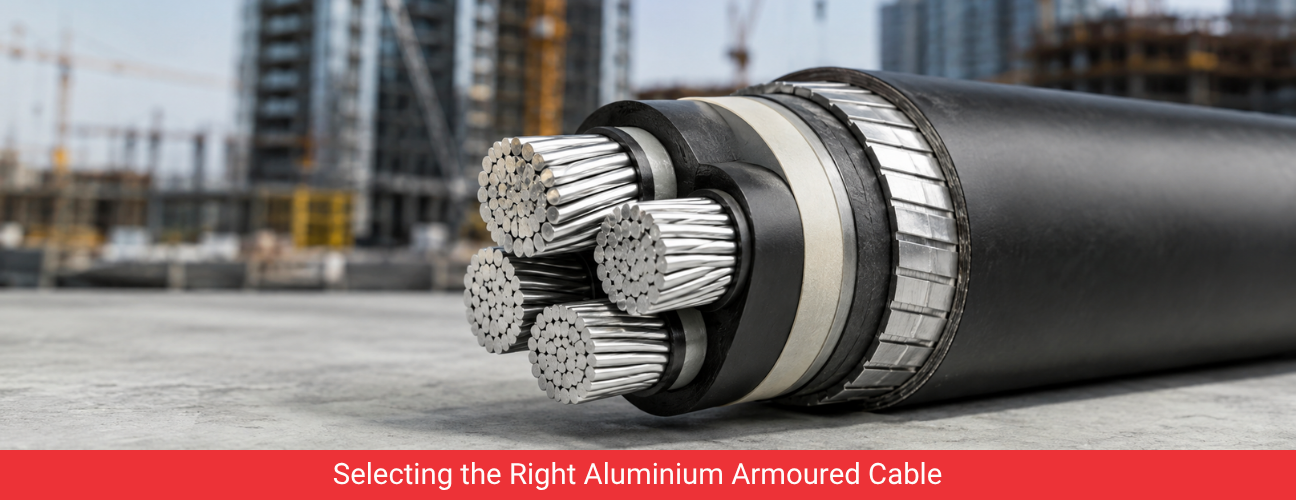
A standard 1.1kV aluminium armoured cable consists of a stranded aluminium conductor, XLPE or PVC insulation, an inner sheath, a layer of galvanised steel wire or steel strip armour, and an outer PVC or FRLS sheath. The armour provides mechanical protection during laying and throughout the service life of the cable, and also serves as a fault current return path when properly earthed at both ends. Aluminium conductors are available in single core through four core and 3.5 core configurations to suit different load and neutral requirements.
Core Configuration Options for Aluminium Armoured Cable
Core Configuration | Typical Application |
Single core | Very high current feeders, often run in trefoil formation |
Twin core (2 core) | Single phase power circuits and street lighting feeders |
Three core | Three phase circuits without a neutral requirement |
3.5 core | Three phase circuits with a reduced size neutral conductor |
Four core | Three phase circuits with a full size neutral conductor |
The choice between three core, 3.5 core and four core aluminium armoured cable depends on the expected neutral current in the circuit. Balanced three phase loads with minimal neutral current can use 3.5 core cable, where the neutral conductor is sized smaller than the phase conductors, while circuits feeding significant single phase or non linear loads, common in lighting and IT loads, are better served by a full size four core cable to safely carry higher neutral current.
Aluminium Armoured Cable Selection Based on Load Current
As with copper cable, aluminium armoured cable sizing begins with the full load current of the circuit, followed by application of derating factors for ambient temperature, grouping and installation method, then a check against voltage drop and short circuit withstand requirements. Because aluminium has lower conductivity than copper, an aluminium conductor typically needs to be one or two standard sizes larger than a copper conductor to carry the same current, which project teams should account for early in panel and gland plate design.
- Calculate the full load current of the circuit, including margin for motor starting current if applicable.
- Select a trial aluminium conductor size from the manufacturer current rating table for the intended installation method.
- Apply derating factors for ambient temperature, grouping and, if buried, soil thermal resistivity.
- Check voltage drop over the full cable run length against the project specification limit.
- Verify short circuit withstand of the selected aluminium conductor against the fault level and protective device clearing time.
- Confirm the final size satisfies current rating, voltage drop and short circuit checks together before finalising the order.
Indicative Current Rating Table for Aluminium Armoured Cable
Conductor Size (sq mm) | Current Rating in Air (A) | Current Rating in Ground (A) |
16 | 62 | 70 |
25 | 80 | 88 |
35 | 98 | 106 |
50 | 118 | 125 |
70 | 150 | 155 |
95 | 182 | 184 |
120 | 210 | 208 |
150 | 240 | 235 |
185 | 273 | 262 |
240 | 320 | 300 |
300 | 365 | 335 |
Testimonials
“Capital Cables made it easy to understand the key factors for selecting the right aluminium armoured cable. The guidance on cable size, insulation, armour and application requirements was clear and useful for our project.”
– Dharmesh Mehta
These figures are indicative and vary by manufacturer, insulation type and number of cores. Final selection should always be confirmed against the specific current rating table provided for the cable being purchased.
Aluminium Armoured Cable Selection for Different Installation Methods
- Buried direct in ground, common for long outdoor feeder runs between substations and buildings, needs cable rated for ground installation with adequate mechanical protection.
- Cable tray installation in industrial plants allows higher current rating than ducted installation due to better heat dissipation, but requires attention to grouping derating when multiple cables share a tray.
- Duct or pipe installation, common in urban infrastructure and road crossings, generally has a lower current rating than open tray installation because heat dissipation is more restricted.
- Trefoil formation for single core cables reduces magnetic field cancellation issues and is standard practice for high current single core feeders.
Point of Interest
Aluminium conductor is roughly one third the weight of copper conductor for a given length, which is a major reason LT aluminium power cable remains the default choice for long outdoor feeder runs where cable weight affects both material handling and support structure design.
Cost Considerations in Aluminium Armoured Cable Selection
Aluminium armoured cable typically costs less per metre than an equivalent current rated copper cable, both because aluminium is a lower cost raw material and because it is lighter, reducing transport and installation labour. Procurement teams comparing 4 core aluminium armoured cable price across sizes, from smaller circuits such as 4 sq mm and 6 sq mm feeders to larger 95 sq mm and 120 sq mm feeders, should evaluate total installed cost, including conductor size adjustment for the lower conductivity of aluminium, rather than comparing raw price per metre against copper cable alone.
Our Other Product
PVC Insulated Winding Wire & 3 Core Flat CablesQuality Checks Before Finalising an Aluminium Armoured Cable Order
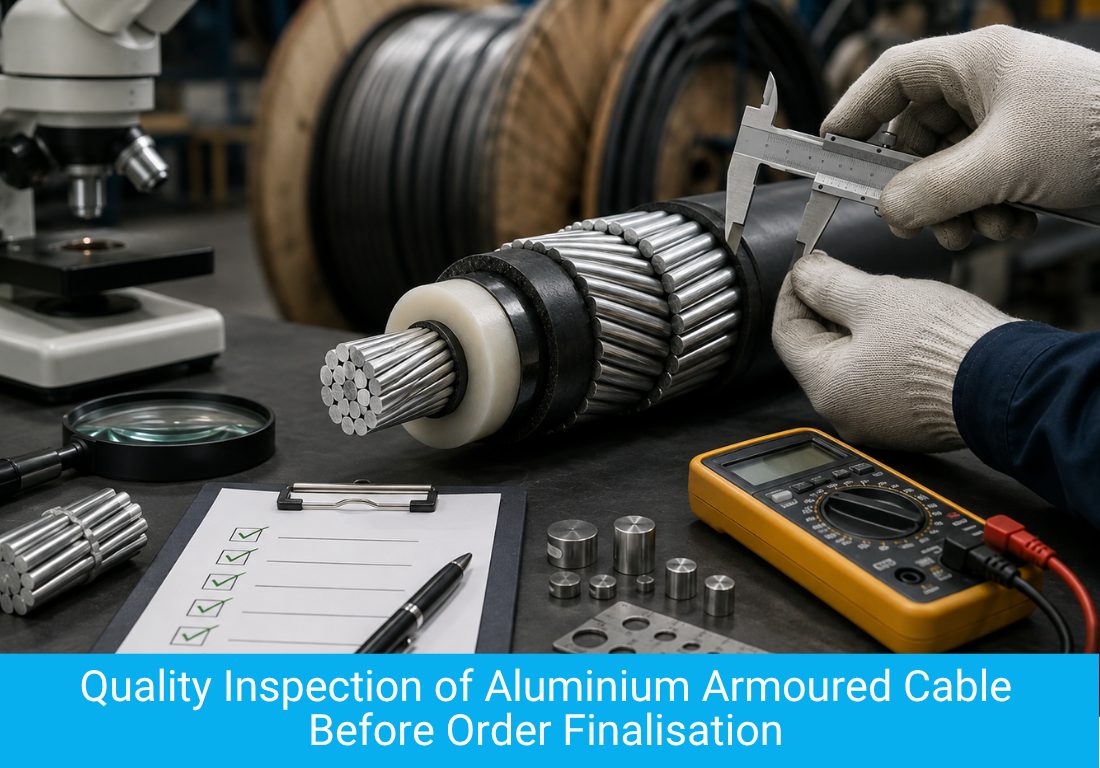
- Confirm conductor material purity and stranding conforms to IS 8130 requirements for aluminium conductors.
- Check insulation and sheath thickness against the applicable Indian Standard for the cable voltage grade.
- Request test certificates for high voltage withstand, insulation resistance and conductor resistance for the specific batch being supplied.
- Verify armour wire or strip gauge matches the declared specification, since armour thickness affects both mechanical protection and short circuit current return capability.
- Confirm drum length and packing meet site requirements to avoid unnecessary jointing on long runs.
Aluminium Armoured Cable Selection for Voltage Drop Sensitive Runs
Because aluminium has lower conductivity than copper, voltage drop becomes a governing factor at shorter cable lengths than it would for an equivalent copper feeder. On long outdoor runs, common for substation to building feeders and street lighting circuits, engineers frequently find that the conductor size needed to satisfy voltage drop is larger than the size that would satisfy current rating alone, and the larger of the two sizes must be selected. Reviewing voltage drop early in the design, rather than as a final check, avoids late stage redesign of gland plates and cable tray capacity.
Aluminium Armoured Cable Selection for Voltage Drop Sensitive Runs
Because aluminium has lower conductivity than copper, voltage drop becomes a governing factor at shorter cable lengths than it would for an equivalent copper feeder. On long outdoor runs, common for substation to building feeders and street lighting circuits, engineers frequently find that the conductor size needed to satisfy voltage drop is larger than the size that would satisfy current rating alone, and the larger of the two sizes must be selected. Reviewing voltage drop early in the design, rather than as a final check, avoids late stage redesign of gland plates and cable tray capacity.
Armour Type Options for Aluminium Armoured Cable
Armour Type | Typical Use Case |
Galvanised steel wire armour | Standard choice for most buried and tray mounted circuits |
Galvanised steel strip armour | Common on larger multicore cables where strip construction suits the cable geometry |
Aluminium wire armour | Used selectively where magnetic losses in single core circuits need to be minimised |
Steel wire and steel strip armour remain the standard choice for the overwhelming majority of 1.1kV aluminium armoured cable used in Indian construction and industrial projects, with the choice between wire and strip construction typically driven by cable diameter and the number of cores rather than by performance differences in most applications.
Our Other Product
HT LXPE CablesMatching Aluminium Armoured Cable to Project Type
Project Type | Typical Aluminium Armoured Cable Use |
Residential and commercial buildings | Riser feeders and DB to DB distribution |
Industrial plants | Machine feeders and plant distribution where copper is not specified |
Infrastructure projects | Street lighting, substation feeders, road crossing ducts |
Renewable energy | Inverter to transformer feeders in cost sensitive installations |
Comparing Aluminium Armoured and Unarmoured Cable Options
Not every circuit needs the added mechanical protection of an armoured construction. Aluminium unarmoured power and control cable is used inside protected environments such as conduit runs, cable ducts within buildings or internal panel wiring, where the cable is not exposed to impact, rodent activity or direct burial conditions. Choosing unarmoured construction where the installation genuinely does not require armour protection reduces both cable cost and installation weight without compromising safety, while any run exposed to mechanical risk should retain the armoured version regardless of the modest cost difference.
Installation Condition | Recommended Construction |
Direct burial in ground | Armoured |
Open cable tray in industrial area | Armoured |
Inside conduit or trunking within a building | Unarmoured acceptable |
Internal panel to panel wiring | Unarmoured acceptable |
Duct bank exposed to future excavation risk | Armoured |
Consultants specifying mixed armoured and unarmoured cable on a single project should clearly mark the transition points on the cable schedule, since site teams sometimes default to whichever construction is readily available in store rather than the construction specified for that particular section of the route.
Sourcing 1.1kV Aluminium Armoured Cable from Capital Cables
Capital Cables (India) Pvt. Ltd. supplies a complete range of 1.1kV aluminium armoured and unarmoured cable, from single core through four core configurations, across the standard cross section range used in Indian construction and industrial projects, as an authorised dealer and distributor of leading Indian cable brands. Selecting the right LT aluminium power cable comes down to matching conductor size, core configuration and sheath type to the specific load, installation method and fire safety requirement of each circuit, and the technical team is available to support consultants and contractors through this selection process for individual project requirements.
Table of Contents