

Table of Contents
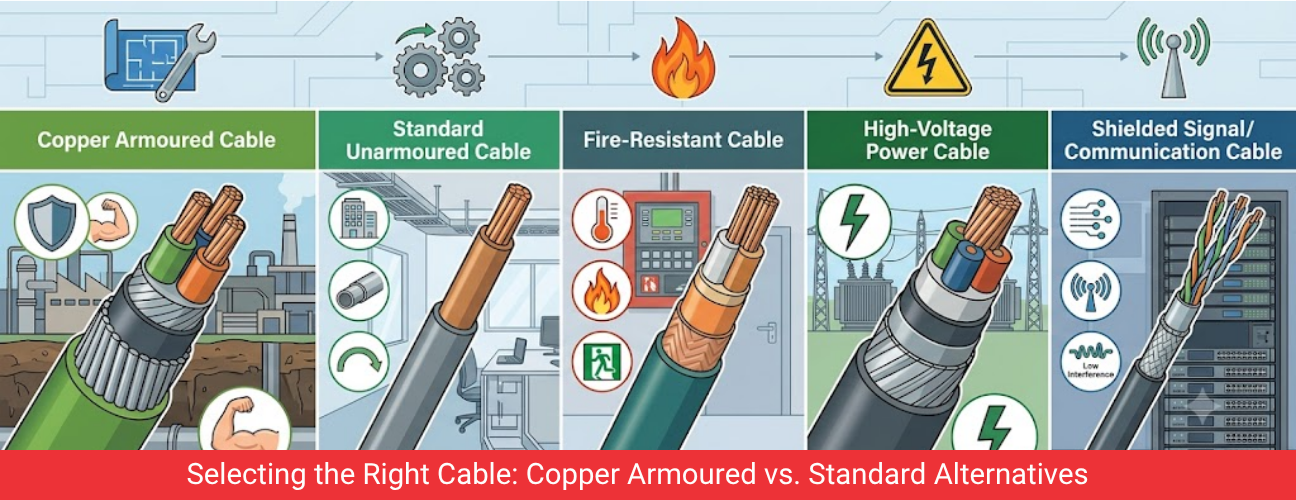
Selecting a cable type is a decision made against a specific set of conditions, movement, fire risk, voltage level, mechanical exposure and signal sensitivity among them. Copper armoured cable is one option among many, and understanding how it compares with other cable types helps consultants and procurement teams specify the right product for each part of a project rather than defaulting to a single cable type across an entire facility.
This comparison is written for readers who already know they need power, control or instrumentation cabling somewhere in a project, and are trying to decide which specific cable family fits each circuit. Ten common comparisons are covered below, each focused on the practical difference that should drive the selection decision on site.
Copper Armoured Cable Versus Flexible Copper Cable
Flexible copper cable uses multiple fine copper strands to allow repeated bending and movement, making it suitable for portable equipment, control panel wiring and applications with vibration. Copper armoured cable, by contrast, includes a steel wire or steel strip armour layer that resists mechanical damage but reduces flexibility. For fixed installations such as underground runs or tray mounted feeders, armoured cable is the correct choice, while flexible cable suits moving equipment, portable tools and internal panel connections.
Copper Armoured Cable Versus LT Power Cable
LT power cable is a broad category that includes both armoured and unarmoured constructions, in copper or aluminium, rated up to 1.1kV. Copper armoured cable is essentially a specific type of LT power cable with added mechanical protection. When specifying an LT power cable, the decision to add armour depends on the installation route, buried, tray mounted or duct routed installations generally call for armoured construction, while cable inside a protected panel or conduit may not need it.
Copper Armoured Cable Versus HT Cable
HT cable, or high tension cable, is rated for voltages well above 1.1kV, commonly 11kV, 33kV and higher, and uses a different insulation thickness and screening design to manage the higher electrical stress. Copper armoured cable at 1.1kV serves LT distribution from transformers and panels to end loads, while HT cable carries power at higher voltage between substations or from a grid connection point to a step down transformer. The two are not interchangeable, and the correct type depends entirely on the voltage class of the circuit being designed.
Parameter | 1.1kV Copper Armoured Cable | HT Cable |
Voltage class | Up to 1.1kV | 11kV, 33kV and above |
Insulation thickness | Comparatively thin | Thicker to manage higher stress |
Screening | Not typically required | Conductor and insulation screening standard |
Typical use | Panel to load, transformer to panel | Substation to substation, grid to transformer |
Copper Armoured Cable Versus Fire Survival Cable
Fire survival cable is designed to keep circuits operational during an actual fire, for a defined period, using mica tape or ceramifiable insulation around the conductor. Standard copper armoured cable, even with an FRLS sheath, is not designed to function during fire exposure, only to limit smoke and flame spread. Fire survival cable is specified for life safety circuits such as fire pumps, emergency lighting, public address systems and smoke extraction fans, while general power and control circuits use standard copper armoured cable.
Copper Armoured Cable Versus FRLS Cable
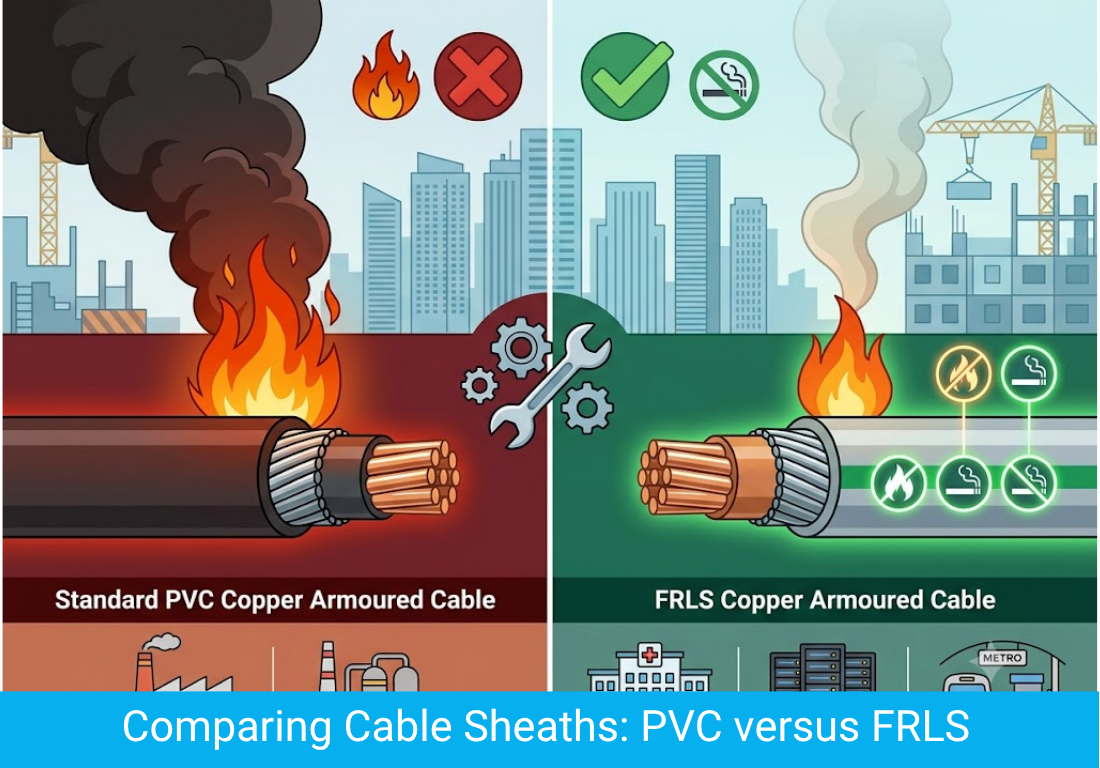
FRLS describes a sheath property, flame retardant low smoke, rather than a separate cable category. A copper armoured cable can itself be manufactured with an FRLS outer sheath. The comparison, in practice, is between a standard PVC sheathed copper armoured cable and an FRLS sheathed copper armoured cable, and the choice depends on the fire safety requirements of the building or plant, with FRLS commonly specified for hospitals, data centres, metro rail and other occupied or enclosed spaces.
Copper Armoured Cable Versus HFFR Cable
HFFR, or halogen free flame retardant, sheath compounds go a step further than FRLS by eliminating halogen content entirely, reducing the release of toxic and corrosive gases during a fire. HFFR sheathed copper armoured cable is specified in facilities where halogen gases would damage sensitive electronic equipment during a fire event, such as data centres and telecom exchanges, while FRLS remains acceptable for many general industrial and commercial applications.
Testimonials
“Installed 3.5-core 185 sq.mm copper armoured XLPE cables across our automotive assembly unit for main feeder runs and heavy motor panels. The mechanical protection from the steel wire armouring is rugged enough to prevent damage from forklift movement over surface trenches. Conductors deliver consistent conductivity with minimal thermal rise even during peak industrial load shifts.”
– Sudhir Deshmukh
Copper Armoured Cable Versus XLPE Aluminium Cable
XLPE aluminium cable uses an aluminium conductor with cross linked polyethylene insulation, and is widely used where cost per metre and installation weight are priorities, since aluminium is lighter and less expensive than copper for a given cross section. Copper armoured cable delivers higher conductivity for the same cross section, meaning a smaller copper conductor can match the current rating of a larger aluminium conductor, which matters where duct space or tray capacity is limited.
Parameter | Copper Armoured Cable | XLPE Aluminium Cable |
Conductivity | Higher, smaller size for same rating | Lower, larger size needed for same rating |
Weight per metre | Heavier | Lighter |
Cost per metre | Higher material cost | Generally lower material cost |
Preferred use | Space constrained, high fault level circuits | Long feeders where weight and cost matter |
Copper Armoured Cable Versus Control Cable
Control cable typically carries signal or control current rather than heavy power load, and is constructed with a larger number of smaller cross section cores, often 1.5 sq mm or 2.5 sq mm, colour coded for easy identification in panels. Copper control cables 1.1kV are frequently supplied in armoured construction for outdoor or buried routing between control panels and field equipment, making the distinction less about copper armoured cable versus control cable and more about power core cable versus multicore control cable within the copper armoured cable family.
Our Other Product
HT LXPE CablesCopper Armoured Cable Versus Instrumentation Cable
Instrumentation cable is built for low level signal transmission, often with individual or overall screening to protect against electrical noise, and typically uses smaller conductor sizes than power cable. Copper armoured cable for power distribution does not include this screening because it is not required for carrying load current. Where a project needs both power feeders and instrumentation signal cabling, as in refineries and power plants, both cable types are used together, each suited to its specific role.
Copper Armoured Cable Versus Solar DC Cable
Solar DC cable is a single core cable designed for outdoor UV exposure, wide temperature range and DC operation between solar panels and inverters, using specialised insulation such as cross linked compounds rated for extended outdoor life. Copper armoured cable at 1.1kV is an AC rated multicore cable used on the grid side of a solar installation, connecting inverters to transformers. The two cable types serve different sections of the same renewable energy project rather than competing for the same application.
Point of Interest
Industry cable selection guides consistently note that no single cable type is universally correct, and that matching insulation, sheath and armour properties to the specific electrical, mechanical and fire requirements of each circuit remains the core principle of good cable specification.
Practical Approach to Choosing Between Cable Types
Consultants generally work through a short sequence of questions when deciding between copper armoured cable and an alternative cable type for a given circuit. Does the circuit need to remain operational during a fire, which points toward fire survival cable. Does the equipment being connected move or vibrate, which points toward flexible cable. Is the voltage above 1.1kV, which points toward HT cable. Is space in the tray or duct limited relative to available budget, which weighs copper against aluminium. Working through these questions circuit by circuit, rather than applying one cable type across an entire project, produces a design that is both technically sound and cost efficient.
Total Cost of Ownership Across Cable Types
Purchase price per metre is only one part of the total cost of a cable installation. Installation labour, the size and cost of cable trays or ducts, the frequency of maintenance inspection and the consequence of a failure in terms of downtime all factor into the real cost of a cable choice over its service life. A slightly more expensive fire survival cable on a life safety circuit, for example, is a minor cost relative to the value of the system it protects, while switching from copper to aluminium armoured cable on a long, low fault level feeder can produce meaningful project savings without compromising performance.
Summary Comparison Table for Quick Reference
Cable Type | Key Differentiator from Copper Armoured Cable |
Flexible Copper Cable | Higher flexibility, used for moving or portable loads |
LT Power Cable | Broader category, armoured version is a subtype |
HT Cable | Higher voltage class, thicker insulation and screening |
Fire Survival Cable | Maintains circuit function during fire exposure |
FRLS Cable | Sheath property, can apply to copper armoured cable itself |
HFFR Cable | Halogen free sheath for sensitive electronic environments |
XLPE Aluminium Cable | Lower conductivity, lighter and generally lower cost |
Control Cable | Signal or control cores rather than power load cores |
Instrumentation Cable | Screened for low level signal transmission |
Solar DC Cable | Single core, DC rated, used on panel to inverter side |
Capital Cables (India) Pvt. Ltd. supplies across most of these categories, including 1.1kV copper armoured and unarmoured cable, LT XLPE cable, HT XLPE cable, FRLS building wire and instrumentation signal cable, as an authorised dealer and distributor, allowing consultants and procurement teams to source correctly matched cable types for every section of a project from a single technically informed supplier.
Table of Contents