

Table of Contents
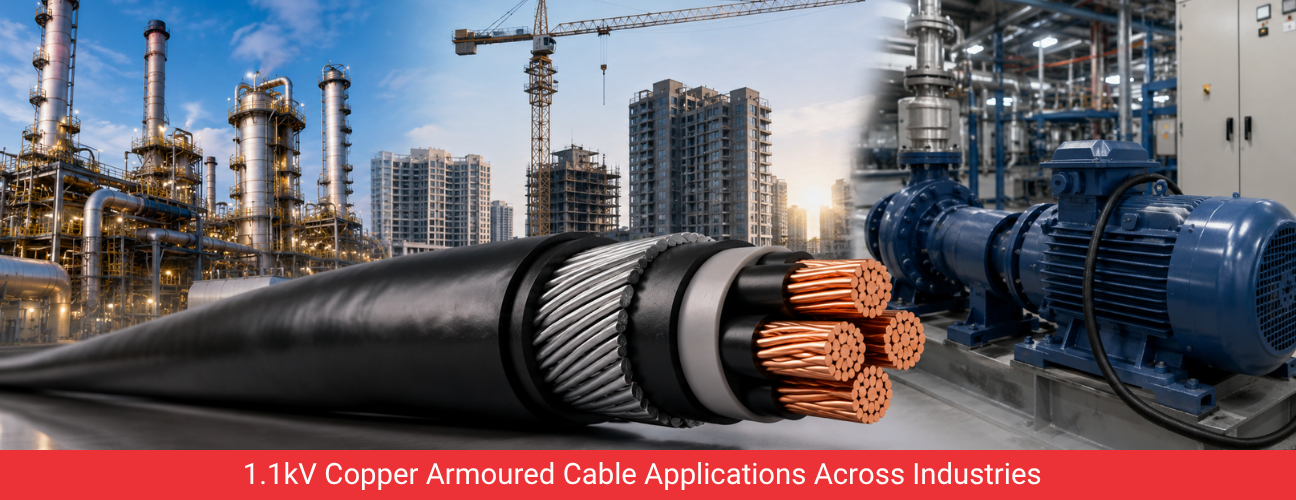
1.1kV copper armoured cable is used wherever a plant or facility needs a power or control connection that is mechanically tough, electrically reliable and safe over a service life of decades. Its steel wire or steel strip armour resists impact, rodent damage and pulling stress during laying, while its copper conductor gives high conductivity and stable performance under sustained industrial loads. This article looks at how different industries in India specify and deploy 1.1kV copper armoured cable, and why the choice of cable changes with the environment of each sector.
Copper Armoured Cable Use in Cement Plants
Cement plants run continuous process equipment such as kilns, crushers, conveyors and raw mills, often in areas with high dust, vibration and temperature. Copper armoured cable is routed through cable trays and underground trenches to feed motor control centres and field motors. The armour protects the cable from mechanical stress caused by heavy equipment movement, and the copper conductor supports the high starting current drawn by large motors during kiln and mill startup.
- Motor feeder cables from MCC panels to crusher and kiln drive motors
- Control cabling between field instruments and the central control room
- Cabling for dust collection and bag filter systems
1.1kV Copper Cable Requirements in Steel Plants
Steel plants operate at high fault levels because of large transformers and arc furnaces, so cable short circuit withstand becomes a primary selection criterion. Ambient temperature near rolling mills and furnaces can be significantly higher than standard conditions, which pushes engineers toward larger conductor sizes after applying temperature derating. Copper armoured cable is preferred for critical circuits such as furnace auxiliaries, rolling mill drives and crane power supply because copper tolerates repeated thermal cycling better over the long term.
Steel Plant Application | Typical Cable Requirement |
Arc furnace auxiliaries | High short circuit withstand, fire resistant outer sheath |
Rolling mill drives | Flexible or armoured copper cable depending on movement |
Crane power and control | Copper control cables 1.1kV with trailing capability |
Cooling water pump motors | Copper armoured cable with moisture resistant sheath |
Refinery and Petrochemical Sector Copper Armoured Cable Needs
Refineries and petrochemical facilities classify large parts of the plant as hazardous areas because of flammable vapours. Cabling in these zones must resist chemical exposure, UV radiation and mechanical damage while meeting fire performance requirements such as flame retardant low smoke, commonly called FRLS, or in more critical circuits, fire survival cable. 1.1kV Copper armoured cable with an FRLS outer sheath is widely specified for power and control circuits feeding pumps, compressors and instrumentation across process units.
- Power feeders to pumps and compressors in process areas
- Instrumentation and signal cabling between field transmitters and control rooms
- Emergency shutdown and fire and gas detection system wiring
Read Our Article
Different Core Aluminum Armoured Cables – An OverviewData Centre Copper Armoured Cable Specification
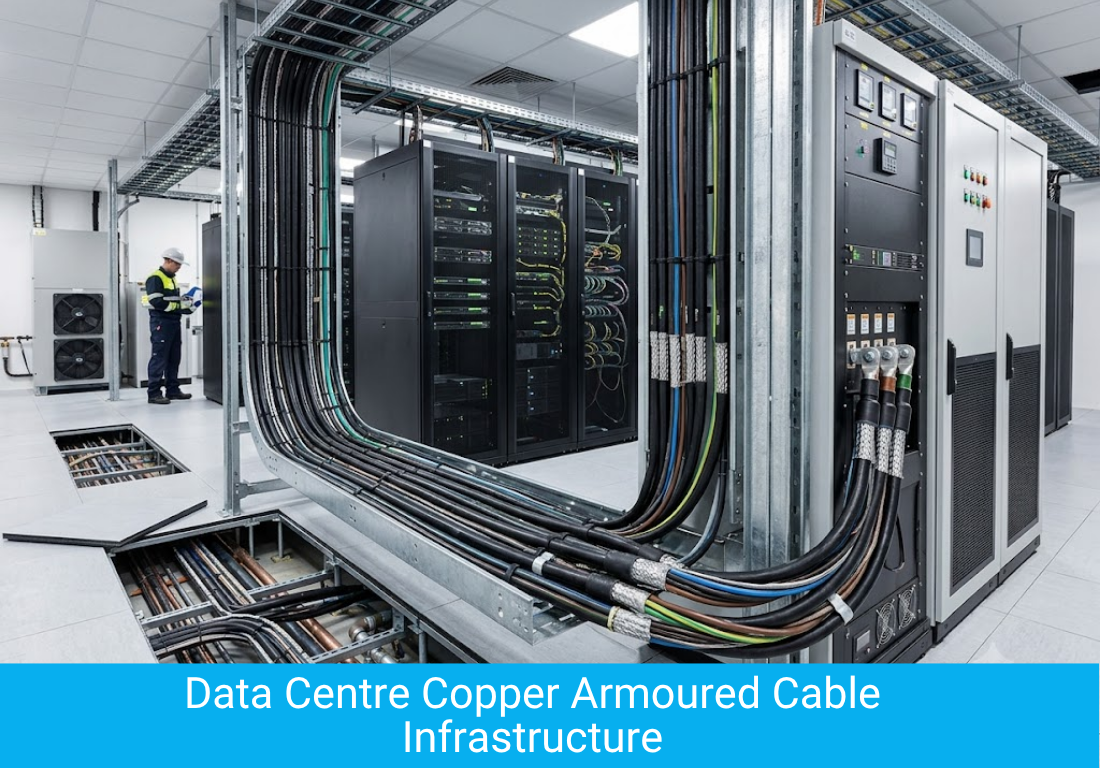
Data centres demand extremely high uptime, so cabling for power distribution units, UPS systems and cooling equipment is specified with margin against overload and with tight voltage drop limits to protect sensitive electronic loads. Copper armoured cable is favoured for its lower voltage drop per metre compared with aluminium cable of the same current rating, which matters in facilities where even small voltage deviations can affect server performance. Fire performance is equally important, and many data centre specifications call for low smoke zero halogen or FRLS sheathed copper cable in cable galleries and raised floor areas.
Airport Electrical Infrastructure and Copper Cable Selection
Airports run runway lighting, terminal power distribution, baggage handling systems and navigation aids, all of which need dependable power feeds with minimal downtime risk. Copper armoured cable is used extensively for underground and duct bank installations feeding substations, taxiway lighting transformers and terminal building panels, since the armour withstands the mechanical stress of duct pulling and the copper conductor supports long cable runs from substations to distant airfield loads without excessive voltage drop.
Our Other Product
SwitchgearsHospital Power Cabling and Copper Armoured Cable Reliability
Hospitals require uninterrupted power for operation theatres, intensive care units and diagnostic equipment such as imaging systems. Copper armoured cable is specified for its low resistance and stable performance, which supports the tight voltage regulation that sensitive medical equipment needs. Fire safety codes for healthcare buildings typically call for FRLS or low smoke sheathed cable so that in the rare event of a fire, smoke generation along escape routes stays minimal.
Metro Rail and Copper Cable for Signalling and Traction Auxiliaries
Metro rail systems use copper armoured cable for auxiliary power, signalling circuits, platform lighting and station equipment. Underground sections in particular demand cable that resists moisture ingress and mechanical damage from tunnel installation, while fire performance is critical because tunnels restrict smoke evacuation. Copper control cables 1.1kV are also used extensively for interlocking and signalling panels where accuracy and low electrical noise are essential for safe train operation.
Testimonials
“Capital Cables has been a reliable source for quality 1.1kV copper armoured cables for our infrastructure requirements. The cables offered good mechanical protection, dependable electrical performance, and were suitable for demanding industrial and project applications. Their team was responsive and helped us select the appropriate cable specifications for our requirements. Overall, a professional and dependable cable supplier.”
– Patel Ramesh
Renewable Energy Projects and Copper Armoured Cable Use
Solar and wind power projects use a mix of cable types depending on the section of the plant. While solar DC cable connects panels to inverters, copper armoured cable at 1.1kV handles the AC side, connecting inverters to transformers and transformers to the grid interconnection point. Wind projects use copper armoured cable within the turbine tower and nacelle for auxiliary power and control, where the armour protects against the mechanical movement and vibration typical of a turbine structure.
Power Plant Applications of 1.1kV Copper Armoured Cable
Thermal, gas and hydro power plants use large quantities of copper armoured cable for auxiliary power systems, feeding boiler feed pumps, cooling water pumps, coal handling plant equipment and instrumentation. Power plants often specify copper over aluminium for auxiliary circuits with high fault levels near the generator transformer, since copper conductor of a smaller size can match the short circuit withstand of a larger aluminium conductor, saving space in crowded cable trenches and trays.
Industry | Primary Reason Copper Armoured Cable Is Preferred |
Cement Plants | Mechanical protection and high motor starting current support |
Steel Plants | High short circuit withstand and thermal cycling tolerance |
Refineries | Fire performance and chemical resistance in hazardous areas |
Data Centres | Low voltage drop and stable supply for sensitive loads |
Airports | Long duct runs with minimal voltage drop |
Hospitals | Voltage stability for critical medical equipment |
Metro Rail | Moisture resistance and fire safety in tunnel sections |
Renewable Energy | Reliable AC side connection from inverter to grid |
Power Plants | Space saving conductor size at high fault levels |
Point of Interest
The CBIP Manual on Power Cables notes that conductor material selection in industrial plants is frequently driven as much by fault current withstand and available trench or tray space as by simple cost per metre, which is why copper remains standard for many critical auxiliary circuits despite its higher base price than aluminium.
Environmental Factors That Change Cable Specification by Industry
The choice between armoured and unarmoured construction, and between PVC, FRLS or HFFR sheath, changes from one industry to another based on three recurring environmental factors, mechanical exposure, fire risk profile and chemical or moisture exposure. A cement plant with heavy vehicle movement near cable trenches needs stronger mechanical protection than a data centre with a controlled raised floor environment, while a refinery handling flammable process fluids needs stricter fire performance than a metro rail station platform, even though both may specify copper armoured cable as the base product.
Our Other Product
LT XLPE Cables (Unarmoured/Armoured)Environmental Factor | Industries Where It Dominates Selection |
Heavy mechanical exposure | Cement plants, steel plants, ports and material handling |
High fault current levels | Steel plants, power plants, large industrial substations |
Strict fire and smoke limits | Hospitals, data centres, metro rail, airports |
Chemical and moisture exposure | Refineries, petrochemical plants, water treatment facilities |
Long outdoor duct runs | Airports, renewable energy sites, power plants |
Procurement Considerations Across Industrial Sectors
Procurement teams across these sectors evaluate copper armoured cable suppliers on similar criteria even though the end application differs widely. Consistent conductor quality, correct armour gauge, valid test certification for every batch and the ability to supply project specific cross sections in adequate quantity all matter whether the buyer is a cement plant maintenance department or a hospital facilities team. Working with a single technically capable supplier across multiple sites also simplifies standardisation of cable specifications within a group of companies operating plants in different sectors.
Choosing the Right Copper Armoured Cable Partner
Capital Cables (India) Pvt. Ltd. supplies 1.1kV copper annealed armoured and unarmoured cable along with copper control cables 1.1kV suited to the demanding conditions found in cement plants, steel plants, refineries, data centres, airports, hospitals, metro rail projects, renewable energy installations and power plants, drawing on its position as an authorised dealer and distributor of leading Indian cable brands. Each application places a different combination of demands on mechanical strength, fire performance and electrical rating, and cable selection should always be matched to the specific environment and load profile of the project.
Technical teams supporting these sectors typically review the plant layout, expected fault levels and applicable fire code before recommending a final cable specification, since a cable that performs well in one industrial setting may not be the optimal choice once armour type, sheath compound and conductor size are weighed against the operating conditions of a different sector.
Procurement teams evaluating cable requirements across a portfolio of sites, for example a group operating both a cement plant and a data centre, benefit from a supplier able to explain how the same base cable range adapts across such different environments, rather than treating each project as an isolated purchase.
Table of Contents