

Table of Contents
Introduction: Why Industrial Power Distribution Demands Copper Armoured Cables
Industrial power cables distribution operates in a fundamentally different environment from residential or standard commercial electrical installations. Factory floors expose cables to mechanical impact, vibration, chemical spillage, oil contamination, and rodent environments. Data centre power infrastructure demands zero-fault-tolerance reliability with absolute cable current capacity accuracy. Solar power plant DC and AC cabling must withstand outdoor UV exposure, temperature extremes, and the consequences of any insulation failure in a high-voltage DC environment. Metro rail and infrastructure projects specify cables that must perform reliably for 30 to 40 years with no possibility of easy replacement.
In every one of these industrial environments, the copper armoured cable is the electrical engineer’s choice for power distribution: it combines the conductivity advantage of copper with the mechanical protection of steel wire armour and the insulation performance of XLPE or PVC compound – creating a ‘install and forget’ power cable that can withstand the conditions that industrial environments impose.
Capital Cables (India) Pvt. Ltd. is an authorised dealer, distributor and supplier of copper armoured cables from Polycab, Havells and KEI – three brands that collectively supply the majority of India’s power cables requirements. This article explores the specific cable requirements of six major industrial application sectors and explains why copper armoured cables from Capital Cables are the correct specification for each.
Industrial Application 1: Manufacturing Factories and Industrial Plants
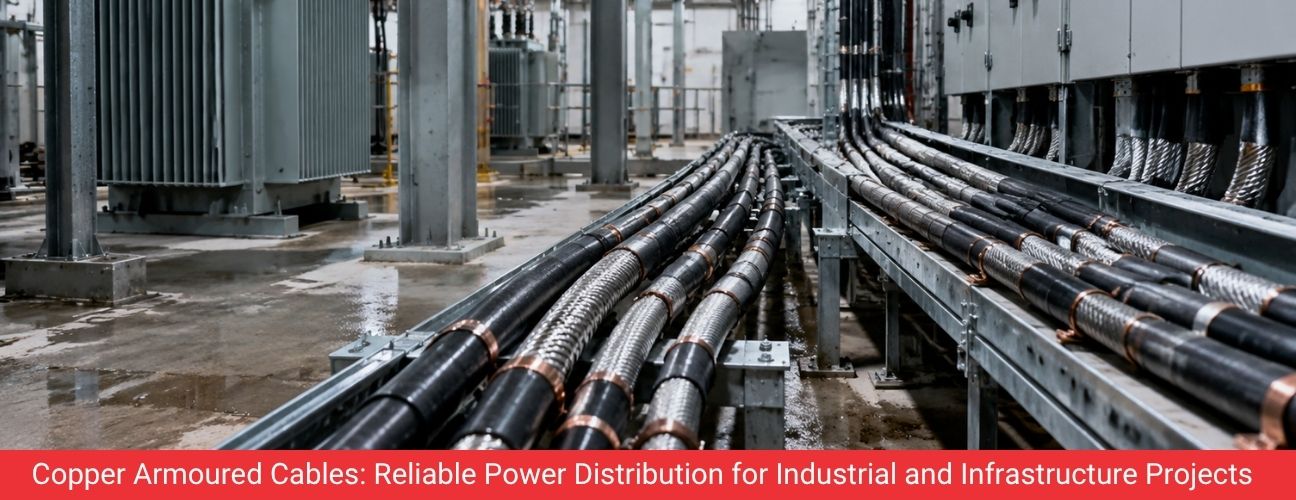
Manufacturing factories represent the largest single application segment for copper armoured cables in industrial India. From automotive component plants in Gurgaon and Manesar to pharmaceutical manufacturing facilities in Baddi and food processing plants in the NCR – every factory requires a comprehensive power distribution infrastructure that starts at the utility substation and terminates at individual machine control panels and motor control centres (MCCs).
Factory Power Distribution Architecture
A typical medium-to-large factory electrical distribution cables system uses copper armoured cables at multiple levels:
- Main incomer feeders: HT or LT cables from the utility supply point or on-site transformer to the main LT distribution board (MLDB). For factories with 11 kV supply, HT copper armoured cables conforming to IS 7098 Part 2 carry the incoming supply to the step-down transformer. LT cables from the transformer secondary to the MLDB typically use large cross-section copper armoured cables (150 to 300 sq mm) in 3.5-core or 4-core XLPE SWA configuration
- Sub-distribution feeders: Copper armoured cables from the MLDB to individual panel boards, motor control centres, and distribution boards throughout the factory. These are typically 35 to 150 sq mm depending on the load served
- Final sub-circuit feeders: Copper armoured cables from panel boards to individual large motors, production equipment, and HVAC systems. 10 to 70 sq mm depending on motor rating
- Control and instrumentation feeders: Smaller copper armoured cables (2.5 to 10 sq mm multicore) for power supply to control panels, instrument signal cables systems, and automation equipment
Why Copper Over Aluminium for Industrial Applications
While 1.1Kv Aluminium Four Core (Armoured) cables are used in LT distribution for cost reduction in some applications, copper armoured cables are the specified standard for most industrial plant power distribution in India – particularly for critical feeders and final sub-circuits. The reasons are technical and practical:
- Superior conductivity: Copper’s conductivity advantage over aluminium means smaller conductor cross-sections carry the same current – critical in factories where cable trays, conduits and containment systems have limited space for cable accommodation
- Mechanical connection reliability: Copper terminations are more reliable than aluminium in the vibration environments typical of industrial plants. Aluminium’s tendency to cold-flow under terminal screw pressure can loosen connections over time, introducing resistance and heat at the termination – a primary cause of electrical fires in industrial installations
- No special handling at joints: Aluminium cable joints and terminations require bi-metallic fittings and joint compound to prevent galvanic corrosion. Copper connections are simpler, more reliable, and require no special materials
- Compliance with OEM equipment specifications: Many motor and control panel manufacturers specify copper cable terminations – using aluminium cables requires special adapters that add cost and potential failure points
IS Standards for Factory Power Cables
IS 1554 Part 1 (PVC) and IS 7098 Part 1 (XLPE) are the applicable standards for LT XLPE Cables in factory power distribution. IS 7098 Part 2 applies for HT cables above 1.1 kV. Capital Cables supplies IS-certified Polycab, Havells and KEI copper armoured cables across all sizes required for factory power distribution – from 1.5 sq mm control cables to 300 sq mm main incomer cables.
Industrial Application 2: Data Centres and IT Facilities
Data centre power infrastructure represents the most demanding copper armoured cable application in terms of reliability, current accuracy and documentation requirements. A data centre cable failure – at any voltage level – translates directly into IT system downtime with measurable business impact measured in lakhs or crores per hour. Data centre power cables are therefore specified, designed, and installed to the highest standards of the electrical infrastructure industry.
Data Centre Power Distribution Cable Requirements
A typical data centre power infrastructure uses copper armoured cables at several levels:
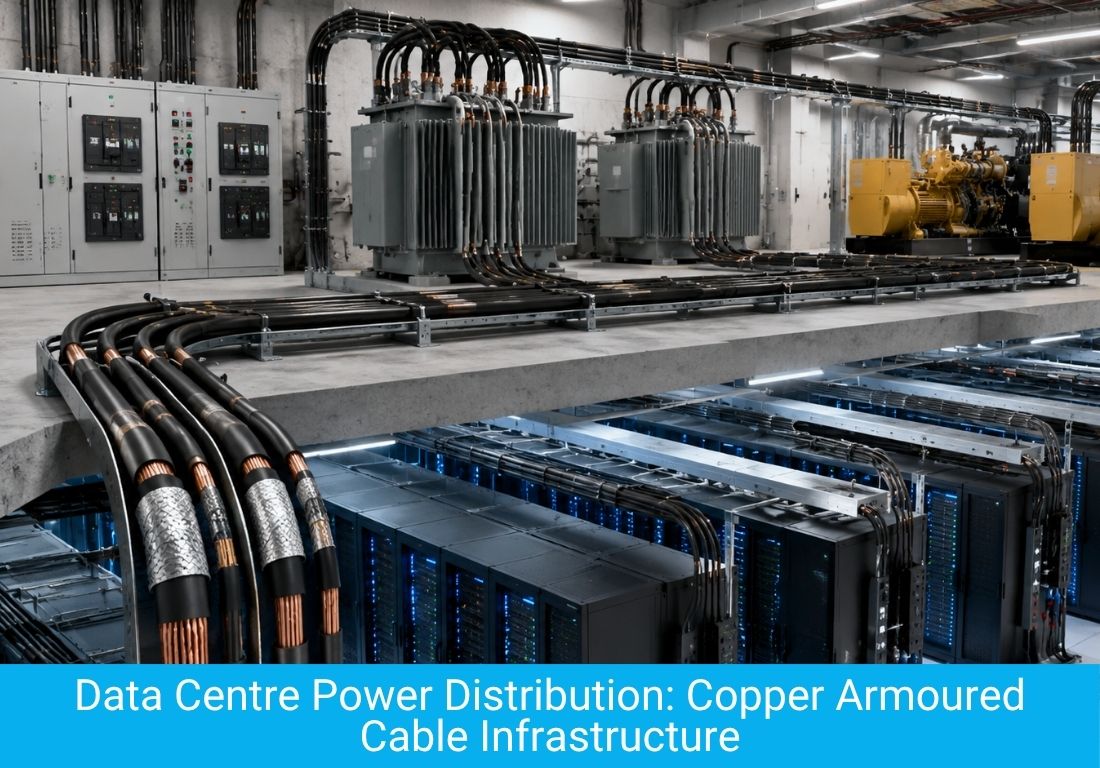
- Utility incomer feeders: HT cables from utility supply to on-site transformers, typically 11 kV XLPE copper armoured cables per IS 7098 Part 2
- UPS input and output feeders: LT copper armoured cables from LT switchboard to UPS systems and from UPS output to downstream distribution – typically 95 to 300 sq mm XLPE SWA in 4-core configuration
- PDU (Power Distribution Unit) feeders: LT copper armoured cables from the LT switchboard or UPS output to in-row or overhead PDUs – typically 25 to 120 sq mm depending on PDU rating
- Generator interconnection cables: LT copper armoured cables for generator paralleling and transfer switching – subject to the full generator fault current capacity
Why XLPE Copper Armoured Cable is Mandatory for Data Centres
Data centres routinely achieve very high cable loading factors – cables run close to their rated current capacity to minimise capital investment in oversized conductors. In this high-loading environment, XLPE insulation’s 90°C maximum conductor temperature versus PVC’s 70°C provides the margin between safe operation and overheating that data centre operators require. XLPE copper armoured cables from Polycab, Havells or KEI – sourced from Capital Cables – are the correct specification for all critical power feeders in data centre environments.
Documentation Requirements for Data Centre Cable Procurement
Data centre project specifications typically require comprehensive cable documentation: type test certificates, BIS certification, conductor resistance test reports, and material composition certificates. Capital Cables facilitates the procurement of all required documentation from Polycab, Havells and KEI for data centre project customers.
Our Other Products
Flexible CablesIndustrial Application 3: Solar Power Plants
India’s solar power capacity has grown dramatically over the past decade, and copper armoured cables are integral components of utility-scale solar plant electrical infrastructure. Solar plants present a unique combination of cable application requirements: outdoor installation in full solar exposure with UV radiation, temperature extremes from cold winter nights to hot summer ground surface temperatures, the specific electrical characteristics of DC systems (particularly the protection requirements of high-voltage DC), and the 25-year asset life expectation of solar infrastructure investment.
Solar Plant Cable Applications
- DC collection cables: In utility-scale solar plants, DC cables from string combiner boxes or tracker combiner boxes to the central inverter. Single-core XLPE copper armoured cables are typically specified for DC collection runs – either direct buried or in HDPE duct on cable trays. The high DC voltage (typically 600 to 1500 V DC in modern plants) and the continuous nature of DC fault current require cables with the highest quality insulation integrity
- Inverter output AC cables: LT copper armoured cables from inverter AC output to the plant’s LT distribution system or power transformer. These are standard LT AC cables – XLPE SWA multicore copper armoured cables conforming to IS 7098
- Transformer and substation cables: High Tension Power Cable from the step-up transformer to the grid connection point – IS 7098 Part 2 for 11 kV or 33 kV connections depending on plant capacity
Why Copper Armoured Cables Are Preferred for Solar DC Applications
The DC collection environment in a solar plant imposes specific cable quality requirements where copper armoured cables outperform alternatives. The continuous high DC voltage demands insulation integrity that XLPE provides better than PVC. The underground or surface routing through the plant field exposes cables to mechanical damage risk during O&M activities – the steel wire armour provides the mechanical protection that prevents costly cable replacement during the plant’s operational life. And the 25-year investment horizon of solar infrastructure makes the lifecycle performance advantage of copper conductors over aluminium in termination reliability particularly significant.
Testimonials
“nstalled 3.5-core 185 sq.mm copper armoured XLPE cables across our automotive assembly unit for main feeder runs and heavy motor panels. The mechanical protection from the steel wire armouring is rugged enough to prevent damage from forklift movement over surface trenches. Conductors deliver consistent conductivity with minimal thermal rise even during peak industrial load shifts.”
– Sudhir Deshmukh
Industrial Application 4: Metro Rail and Transportation Infrastructure
Metro rail infrastructure represents one of India’s most demanding copper armoured cable application environments – combining high current traction power distribution, safety-critical signalling and communications power, and the absolute requirement for operational continuity that public transportation safety demands. Delhi Metro, Mumbai Metro, Bengaluru Metro and metro systems across India specify copper armoured cables for their critical power distribution infrastructure.
Metro Rail Cable Applications
- Traction power distribution: HT XLPE Cables and LT copper armoured cables distributing power from traction substations to track sections, third rail systems or overhead catenary infrastructure
- Station power distribution: LT copper armoured cables for station lighting, escalator power, ventilation systems, platform screen door systems, and train control room power supply
- Signalling and control power: Multicore copper armoured cables for power supply to signalling equipment, interlocking systems, and communication infrastructure along the track alignment
- Tunnel emergency systems: LSZH (Low Smoke Zero Halogen) copper armoured cables for emergency lighting and evacuation power supply within tunnel sections – required to maintain circuit integrity and produce minimal toxic smoke in the event of fire
Specification Standards for Metro Rail Cables
Metro rail projects typically specify cables under RDSO (Research Designs and Standards Organisation) standards in addition to IS standards. RDSO specifications for cables used in Indian railway infrastructure add specific requirements for mechanical performance, fire resistance, and electrical testing. Capital Cables can supply Polycab, Havells and KEI cables manufactured to these combined IS and RDSO specifications for metro and railway infrastructure projects.
Industrial Application 5: Hospitals and Healthcare Facilities
Hospitals and healthcare facilities have power distribution requirements that combine the complexity of industrial electrical systems with the absolute safety imperatives of a medical environment. A power supply interruption in a hospital – to an operating theatre, intensive care unit, or life support equipment – is a direct threat to patient safety. This creates a cable specification environment that prioritises reliability and fault tolerance above all else.
Hospital Power Distribution
- Normal supply distribution: Copper armoured cables carrying normal utility supply power to non-critical loads throughout the hospital – lighting, HVAC, general power outlets
- Essential supply distribution: Copper armoured cables on the essential supply branch (fed from UPS or automatic transfer to generator) to critical areas – operating theatres, ICUs, emergency departments, medical imaging equipment rooms
- Life support supply distribution: Dedicated copper armoured cables for life-critical loads – ventilators, heart-lung bypass machines, monitoring equipment – typically on a dedicated UPS feed with the highest reliability specification
- Medical gas plant power supply: Copper armoured cables for the power supply to medical gas compression plants (oxygen, nitrogen, medical air) – classed as essential supply with generator backup
Why XLPE Copper Armoured Cables Are Standard for Hospitals
Hospital power distribution cables must provide long operational life with minimal risk of insulation failure – the consequences of an in-service cable fault in a medical environment are unacceptably severe. XLPE-insulated copper armoured cables from Polycab, Havells or KEI provide the combination of high operating temperature margin, superior ageing resistance, and mechanical protection through SWA armouring that hospital power distribution requires. Capital Cables supplies hospital project cables with full IS certification documentation and manufacturer quality certificates for inclusion in hospital electrical installation records.
Our Other Products
PVC Insulated Winding Wire & 3 Core Flat CablesIndustrial Application 6: Renewable Energy and Power Infrastructure
Beyond solar, India’s renewable energy infrastructure expansion encompasses wind power, hydroelectric, and energy storage projects – all of which require copper armoured cables for their power collection and distribution infrastructure. Additionally, the modernisation of India’s conventional power generation and transmission infrastructure – thermal power station auxiliary systems, grid substation cable interconnections, and distribution automation projects – creates sustained industrial demand for large cross-section copper armoured cables meeting the highest quality standards.
For wind power projects, LT copper armoured cables connect individual wind turbine generators to the wind farm collection system. High Tension Cables carry the collected wind farm power to the grid connection substation. Both applications require cables rated for continuous outdoor or underground service in coastal or high-altitude environments where wind, UV radiation, and temperature variation are more extreme than standard industrial environments.
Capital Cables: Industrial Supply Capability Across All Applications
Capital Cables has supplied copper armoured cables to industrial projects across Delhi, NCR and North India spanning all the application sectors covered in this article. Our industrial supply capability includes:
- Complete inventory of Polycab, Havells and KEI copper armoured cables in IS 1554 (PVC) and IS 7098 (XLPE) for LT applications, and IS 7098 Part 2 for HT applications
- Copper armoured cables in all standard sizes from 1.5 sq mm to 300 sq mm – covering industrial control cable sizes through main incomer feeder sizes
- Technical support for custom industrial cables specifications including IS standard confirmation, type test certificate availability, and third-party test report facilitation
- Single-source supply for complete industrial project cable schedules – from small control cables to large main feeder cables – across Polycab, Havells and KEI
- Project logistics support including drum delivery management, site delivery scheduling, and supply in phased quantities matching construction programme requirements
- Competitive pricing on project quantities with volume discount structures for large industrial procurement
Industrial Application | Primary Cable Type | IS Standard | Key Requirement |
Factory Power Distribution | XLPE SWA 4-core LT | IS 7098 Part 1 | Mechanical protection, high current |
Data Centre PDU Feeders | XLPE SWA 4-core LT | IS 7098 Part 1 | 90°C rating, documentation |
Solar DC Collection | XLPE STA Single-core | IS 7098 Part 1 | DC voltage, UV resistance |
Metro Rail Distribution | HT/LT XLPE SWA | IS 7098 Parts 1&2 | Fire performance, RDSO compliance |
Hospital Essential Supply | XLPE SWA 4-core LT | IS 7098 Part 1 | Reliability, IS certification |
Wind Farm Collection | XLPE SWA Multi-core | IS 7098 Part 1 | Outdoor durability, HV DC/AC |
Substation Auxiliary | XLPE SWA Multi-core | IS 7098 Part 1 | High operating temperature |
Capital Cables – Industrial Cable Supply Specialists | Polycab, Havells & KEI | Delhi & NCR
📞 Contact: Discuss your industrial project cable requirement with Capital Cables
🌐 Website: capitalcables.co.in
Conclusion: Copper Armoured Cables Are Industrial Infrastructure
The copper armoured cables installed in factories, data centres, solar plants, metro systems, hospitals and industrial infrastructure are not commodities to be purchased at the lowest available price. They are critical infrastructure components whose performance over a 25 to 40-year operational life determines the safety, efficiency and reliability of the industrial systems they power.
Specifying IS-certified copper armoured cables from Polycab, Havells or KEI – sourced from Capital Cables as an authorised dealer – is the correct decision for every industrial application covered in this article. The quality assurance, technical documentation, and supply reliability that authorised sourcing provides are the foundation of industrial electrical infrastructure that performs as designed, for as long as it is needed.
Contact Capital Cables, a leading Cable dealer delhi, for industrial project copper armoured cable requirements across Delhi, NCR and North India. Our technical and commercial team is ready to support your project from specification through supply.
Table of Contents