

Table of Contents
Introduction: Why Copper Armoured Cable Prices Are Never Fixed - and Why That Matters
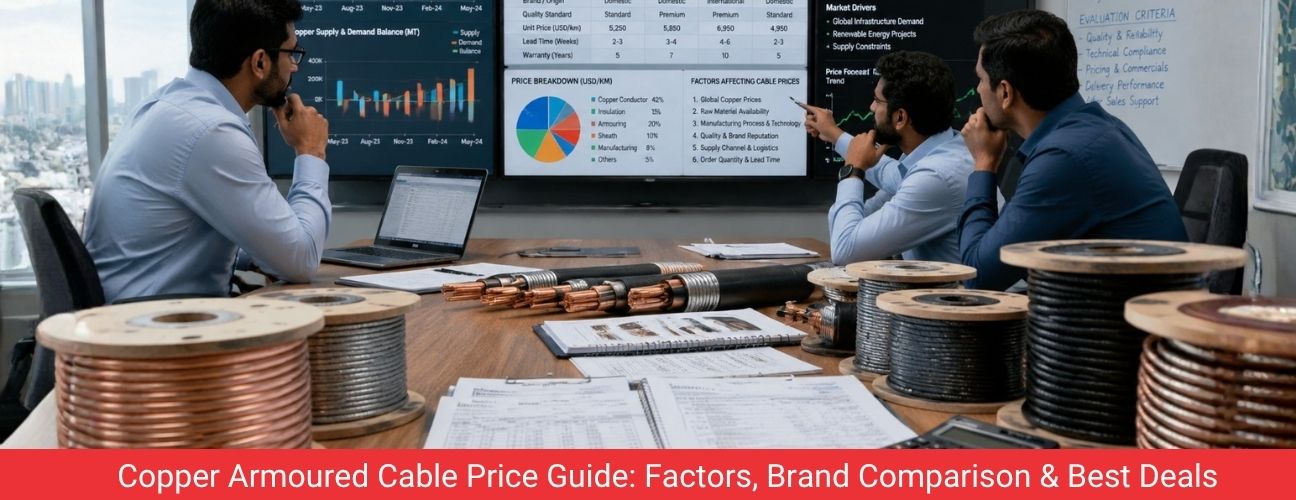
Anyone who has purchased copper armoured cables for a project in India knows the frustration: the price you quoted to your client three months ago is no longer the price you are paying to procure the cable today. Copper armoured cable prices in India are not fixed, seasonal or predictable. They are dynamic – linked directly to the global price of copper, the most economically significant raw material in the cable, and influenced by factors ranging from international commodity markets to domestic manufacturing costs, brand positioning, cable construction specifications, and the supply channel through which you source.
This article is not a price list, because any published price is outdated the moment copper prices move on the London Metal Exchange. What this article provides instead is something more valuable: a clear understanding of what drives copper armoured cable prices, how to interpret price differences between brands and cable types, and how sourcing from an authorised dealer like Capital Cables protects you from the pricing pitfalls of the unorganised market – counterfeit cables, compromised specifications, and artificially low prices that reflect compromised quality rather than genuine value.
Capital Cables (India) Pvt. Ltd. is an authorised dealer, distributor and supplier of copper armoured cables from Polycab, Havells and KEI in Delhi and NCR. We price our cables transparently, based on current manufacturer price lists and commodity-linked adjustments, and we provide current pricing directly to customers on enquiry.
The Dominant Price Driver: London Metal Exchange (LME) Copper Price
Copper is typically 60 to 70 percent of the total manufacturing cost of a copper armoured cable. This means that the single most important factor determining what you pay for a copper armoured cable today – regardless of brand – is the current price of copper on the London Metal Exchange (LME). The LME copper price is the global benchmark for the refined copper used in conductor manufacturing, and it fluctuates daily based on global supply and demand dynamics.
How Cable Manufacturers Price to Copper
Indian cable manufacturers – including Polycab, Havells and KEI – adjust their cable prices in response to LME copper movements. When copper rises significantly on the LME, manufacturer price lists are revised upward. When copper falls, price lists may be revised downward, though manufacturers typically move more quickly to increase prices on upward copper movements than they do to reduce them on downward movements.
For buyers, this means that the copper armoured cable price you were quoted last month may be different from today’s price even for the identical cable specification from the same manufacturer – not because the dealer is being inconsistent, but because the underlying commodity cost has changed. This is why all responsible cable dealers quote prices with a validity period and why Capital Cables always quotes current prices based on the prevailing manufacturer price list rather than working from outdated catalogues.
Rupee-Dollar Exchange Rate Impact
Since LME copper is priced in US Dollars and Indian cable manufacturers buy copper in Indian Rupees, the USD/INR exchange rate adds a second layer of price variability. A weakening Rupee raises the Rupee cost of the same LME copper price, increasing cable manufacturing costs and pushing domestic cable prices higher even if the LME Dollar price has not moved. This is particularly relevant in the current economic environment where exchange rate volatility can have a meaningful impact on cable procurement budgets for projects with long procurement timelines.
Secondary Price Factors: What Makes One Cable More Expensive Than Another of the Same Size
Insulation Type: XLPE Commands a Premium Over PVC
For the same conductor cross-section and the same brand, an XLPE-insulated copper armoured cable (IS 7098) is priced at a premium over a PVC-insulated copper armoured cable (IS 1554). The premium reflects the higher material cost of XLPE compound compared to standard PVC, the more demanding manufacturing process for XLPE cross-linking, and the superior technical performance XLPE delivers – higher operating temperature, better long-term ageing, and higher current ratings. For most underground and industrial applications where XLPE’s advantages directly contribute to lower lifecycle costs, this premium is a sound investment.
Number of Cores
A 4-core copper armoured cable of the same conductor cross-section per core costs more than a 3-core cable, which costs more than a 2-core, which costs more than a single-core. This reflects the direct relationship between copper content and cable cost – more cores mean more conductor copper and more insulation material. Understanding this relationship helps project cost planners accurately estimate cable budgets for multi-feeder distribution systems.
Armour Type: SWA vs STA
The steel wire armour (SWA) used on multicore cables and the steel tape armour (STA) used on single-core cables contribute to the cable’s overall cost – but the variation between SWA and STA is a relatively minor component of the total price compared to the conductor copper content. The choice between SWA and STA should be made on technical grounds (installation method and mechanical protection requirement) rather than on the basis of armour cost differential.
Conductor Cross-Section: The Direct Copper Content Relationship
The most obvious price driver within a brand and cable type is the conductor cross-section. A 150 sq mm copper armoured cable contains approximately 100 times more copper conductor material than a 1.5 sq mm cable of the same type. The price relationship between sizes is roughly proportional to copper content – with manufacturing overheads and material costs for insulation and armouring adding a relatively stable per-metre cost that is proportionally more significant for smaller sizes than for larger ones.
Testimonials
“Capital Cables made it easy to compare copper armoured cable options and understand the pricing for different sizes. The quotation was clear, and the overall purchasing process was smooth.”
– Vikram Mehta
Brand Positioning and Price: Polycab, Havells and KEI
Polycab, Havells and KEI all position their copper armoured cables as premium, IS-certified products – and all are priced accordingly. These are not budget cable brands. However, there are differences in how each brand’s pricing positions relative to the others, and understanding this positioning helps buyers make informed procurement decisions.
Polycab: Scale and Competitive Pricing
Polycab’s position as India’s largest cable manufacturer by volume gives it raw material procurement advantages that can translate into competitive pricing on standard sizes in high-volume procurement. For project buyers sourcing large quantities of standard LT copper armoured cables – the backbone sizes that represent the majority of project cable content by value – Polycab’s pricing tends to be competitive within the premium brand tier. This makes Polycab a particularly strong choice for budget-conscious project procurement where IS certification and brand assurance are non-negotiable but price optimisation on volume is also a priority.
Havells: The Premium Brand Premium
Havells’ positioning as a premium electrical brand – built across decades of consumer advertising and contractor relationship investment – is reflected in its cable pricing. Havells copper armoured cables are generally priced at the upper end of the premium tier. This premium is appropriate for projects where the brand specification is driven by project owner preference, consultant specification, or the overall project quality positioning – and where the procurement decision-maker has the budget and the brief to source accordingly.
Our Other Products
PVC Insulated Winding Wire & 3 Core Flat Cables
KEI: Value in Industrial and Infrastructure Segments
KEI’s pricing in the industrial and infrastructure segment reflects its strong technical track record and the quality assurance it provides for demanding applications. For heavy industrial and EPC project buyers, KEI’s pricing represents value within the premium tier – the combination of technical credibility, comprehensive documentation, and proven industrial performance justifies the investment. For standard commercial and residential applications, KEI’s pricing is also competitive, though the brand’s positioning in the industrial segment means it is less widely specified for purely commercial projects.
The Hidden Cost of the Cheap Cable: Why Unauthorised Sources Cost More in the Long Run
The most dangerous pricing conversation in the copper armoured cable market is the one that starts with ‘I found the same cable much cheaper at a local market.’ The unorganised Indian cable market contains a significant volume of substandard, non-IS-compliant and counterfeit cables that are sold at prices below what IS-certified cables from genuine manufacturers can be produced at – because they are manufactured to different standards.
What Makes a 'Cheap' Copper Armoured Cable Cheaper
- Reduced copper content: Thinner conductors that do not meet the minimum cross-sectional area specified by IS 8130 – meaning the cable cannot safely carry its rated current and will fail prematurely under load
- Substandard insulation compound: Cheaper PVC or XLPE compounds that do not meet the IS dielectric and ageing requirements – resulting in premature insulation failure, particularly in high ambient temperature environments
- Inadequate armour: Lighter steel wires or tapes that do not provide the mechanical protection of IS 3975 compliant armour – compromising the cable’s ability to withstand mechanical damage in underground or exposed installations
- No BIS certification: Cables sold without ISI marking have not been tested and certified as complying with the relevant IS standard – meaning there is no independent quality assurance on the product you are installing
The Real Cost of Using Substandard Cable
An electrical cable failure in an underground installation typically costs far more to diagnose and repair than the cost difference between the substandard cable originally installed and the IS-certified cable that should have been used. Excavation, fault finding, cable replacement, reinstatement, project delays and consequential losses from power supply interruption can collectively amount to many times the cable cost saving – in addition to the safety risk from electrical faults in systems powered by cables whose integrity is compromised.
Sourcing copper armoured cables from Capital Cables – an authorised dealer for Polycab, Havells and KEI – guarantees that every cable supplied is genuinely manufactured by the specified brand, meets the relevant IS standard, carries a valid BIS licence, and comes with full manufacturer quality documentation. This is the price assurance that matters more than any short-term price saving.
How to Get the Best Price on Copper Armoured Cables from Capital Cables
Request Prices Based on Current LME Copper Rates
Always request a current quotation from Capital Cables rather than working from memory of past prices or published indicative lists. The capital cost of copper in your cable procurement is genuinely different today from what it was last quarter, and accurate current pricing is essential for project cost management.
Specify Your Complete Cable Requirement
Provide Capital Cables with your complete cable schedule – all sizes, types, lengths, and brands required for your project. Consolidated purchase orders enable better volume pricing and supply prioritisation compared to piece-meal procurement.
Our Other Products
Aerial Bunched CablesCompare Across Brands for Standard Size Runs
For standard LT copper armoured cable sizes where all three brands offer technically comparable products meeting the same IS standard, ask Capital Cables to compare current pricing across Polycab, Havells and KEI. Where there is no project-specific requirement for a particular brand, choosing the most competitively priced IS-certified option from an authorised source optimises project cable cost without compromising quality.
Consider XLPE vs PVC on a Lifecycle Cost Basis
XLPE copper armoured cables carry a price premium over PVC cables of the same size. For underground and industrial applications, evaluate the XLPE premium against the lifecycle cost benefits: higher current rating (potentially allowing a smaller conductor cross-section than PVC for the same load, partially offsetting the insulation premium), better long-term ageing, and lower risk of premature insulation failure that would require costly cable replacement.
Plan Procurement Lead Times to Avoid Urgency Premiums
Copper armoured cables in very large conductor sizes (150 sq mm and above) may not always be immediately ex-stock in all configurations. Planning cable procurement early – before the construction programme creates urgency – allows Capital Cables to source at regular supply pricing rather than expediting at premium cost.
Capital Cables: Transparent Pricing, Authorised Supply, Technical Support
Capital Cables provides copper armoured cable pricing based on current manufacturer price lists, updated to reflect prevailing LME copper rates and applicable taxes. Our pricing is transparent – we do not add hidden margins or supply charges beyond those disclosed in our quotation. As an authorised dealer, distributor and supplier for Polycab, Havells and KEI, our prices are competitive within the authorised distribution channel and our supply comes with the quality assurance that only authorised sourcing can provide.
- Current, accurate pricing provided on enquiry – not from outdated catalogues or published lists that cannot reflect today’s market
- Volume discount availability for project quantities across all three brands
- Price validity confirmation on quotations to support your project cost management
- Complete technical documentation including IS test certificates and manufacturer quality certificates at no additional cost
- Consistent supply pricing from order placement through delivery – no undisclosed price revisions after order confirmation
Conclusion: The Right Price is the Current Authorised Price
The right copper armoured cable price for your project is not the lowest price available in the market – it is the most competitive price available from an authorised, IS-compliant source. The difference between those two prices represents the risk premium you avoid by sourcing from Capital Cables: the risk of substandard cable, of installation failure, of regulatory non-compliance, and of the far greater costs that come with those outcomes.
Contact Capital Cables for a current quotation on Polycab, Havells or KEI copper armoured cables for your project. Our team will provide transparent, current pricing with full quality assurance – so you can procure with confidence.
Table of Contents