

Table of Contents
Introduction: Why Underground Installation is the Primary Use Case for Copper Armoured Cables
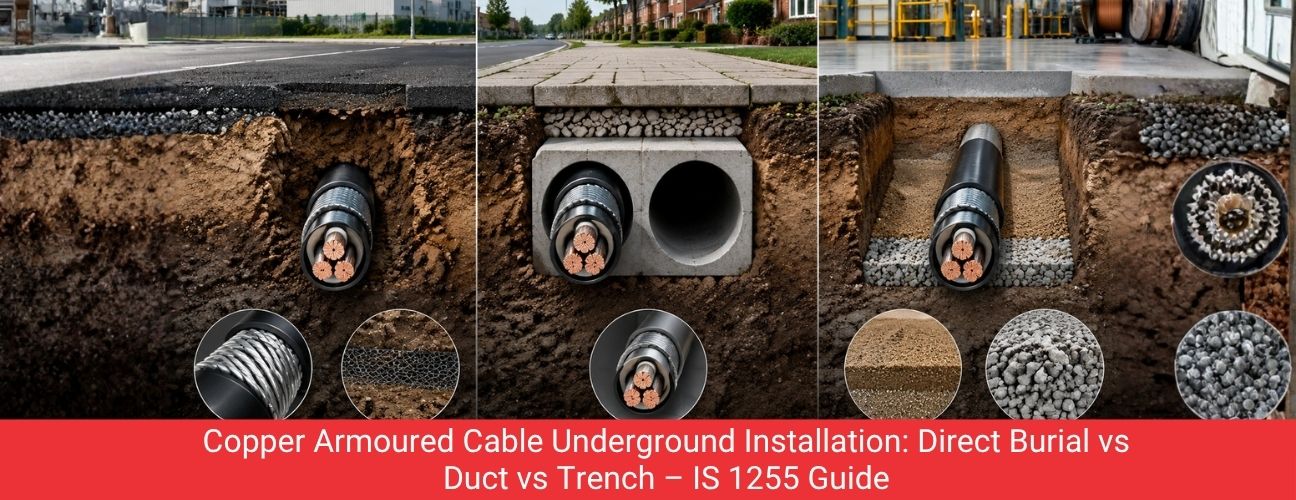
Underground power cables distribution is the backbone of India’s built environment – from the feeder cables running under factory floors and industrial compounds to the distribution mains buried beneath roads and pavements in residential townships, commercial complexes and infrastructure projects. The copper armoured cable exists precisely for this purpose: it is mechanically designed to survive the underground environment, withstand soil movement and moisture ingress, resist rodent attack, and deliver reliable power for decades without the possibility of direct inspection or maintenance intervention.
Yet the fact that a cable is ‘armoured’ does not mean it can be installed underground without care. The way a copper armoured cable is installed underground – the method chosen (direct burial, duct installation, or open trench), the burial depth, the bedding and covering materials, the type of cable selected – all have a direct bearing on how the cable performs over its 25-to-30-year operational life. An IS 1255-compliant installation protects the cable from mechanical damage during soil movement, thermal stress from inadequate cover, and premature insulation failure from moisture ingress at improperly sealed entry points.
This guide covers the three primary underground cable installation methods in detail, with specific guidance on copper armoured cable selection for each method and practical compliance requirements under IS 1255 – India’s principal standard for the installation and maintenance of power cables. Capital Cables, as an authorised dealer, distributor and supplier of Polycab, Havells and KEI copper armoured cables in Delhi and NCR, supplies IS-certified cables for all underground installation applications.
Why Copper Armoured Cables are Specified for Underground Installation
The underground environment presents a set of specific hazards that unarmoured cables cannot reliably withstand:
- Mechanical stress: Soil movement due to settlement, frost heave (in northern India during winter), and surface loads from vehicles or excavation equipment impose direct mechanical forces on buried cables
- Rodent attack: Rats and other rodents can gnaw through PVC outer sheaths and insulation – the steel wire armour of a copper armoured cable provides the rodent resistance that underground cables must have
- Moisture ingress: Ground moisture at varying water table levels can attack cable insulation if the outer sheath is compromised – armoured cables with proper outer sheath integrity provide a robust moisture barrier
- Soil chemical attack: Certain soil types – particularly in industrial areas – contain chemicals (sulphates, acids) that can attack cable outer sheaths over time. Armoured cables with suitable outer sheath compounds resist this attack better than unsheathed cables
- Third-party damage: Subsequent excavation by other utilities or construction activities near buried cables represents a major cause of cable failure. The steel armour provides some protection against accidental dig-in damage, particularly with shallower cover
Steel Wire Armour (SWA) copper armoured cables conforming to IS 1554 (PVC) or IS 7098 (XLPE) are the industry standard for all underground power distribution applications in India. Capital Cables supplies SWA copper armoured cables from Polycab, Havells and KEI across the full size range for underground applications.
Underground Installation Method 1: Direct Burial
Direct burial is the most widely used underground cable installation method in India for LT distribution – particularly in industrial compounds, residential campus developments, and commercial properties. The cable is laid directly in a prepared trench, covered with protective materials, and backfilled. This method is cost-effective, does not require any conduit or duct infrastructure investment, and provides good thermal dissipation since the cable is in direct contact with soil.
Trench Preparation
IS 1255 specifies trench width and preparation requirements for direct burial installations. The trench should be wide enough to accommodate the cable(s) with adequate spacing, and the trench bottom should be smooth and free from sharp stones, rubble or debris that could damage the cable outer sheath during laying.
- Trench bottom preparation: A 75 mm layer of clean, sifted sand or fine soil should be laid on the trench bottom before the cable to provide a cushioning layer that protects the outer sheath during laying and prevents point contact with sharp stones
- Multiple cables in same trench: Where multiple cables are laid in the same trench, IS 1255 specifies minimum lateral spacing between cables. Cables in close proximity to each other generate mutual heating that reduces the current-carrying capacity – the grouping derating factor applies
- Concrete or tile protection: Where the trench is at risk of subsequent excavation – under roads, footpaths or areas with future utility activity – a protective layer of concrete tiles or protective concrete laid over the cable (after the sand bedding layer) provides additional mechanical protection
Burial Depth Requirements per IS 1255
IS 1255 specifies minimum burial depths for directly buried cables based on voltage level and installation location. These are minimums – deeper burial may be appropriate where surface loads are high or where future excavation is expected:
| Voltage Level | Location | Minimum Burial Depth (IS 1255) |
| LT (up to 1.1 kV) | Under open ground (industrial/residential campus) | 0.75 m (750 mm) |
| LT (up to 1.1 kV) | Under road or footpath | 1.0 m (1000 mm) |
| LT (up to 1.1 kV) | Under railway tracks | 1.5 m (1500 mm) minimum |
| HT (1.1 kV to 11 kV) | Under open ground | 1.0 m (1000 mm) |
| HT (1.1 kV to 11 kV) | Under road | 1.2 m (1200 mm) |
| HT XLPE Cables (33 kV and above) | Under open ground | 1.2 m (1200 mm) minimum |
For direct buried copper armoured cables in Delhi’s NCR region – where the water table can be shallow in monsoon season – LT XLPE Cables from Polycab, Havells or KEI are preferred over PVC-insulated cables. XLPE’s superior moisture resistance and higher operating temperature rating provide a more robust solution for the variable soil conditions encountered in North India.
Cable Route Marking
IS 1255 requires that direct buried cable routes be marked at the surface to prevent accidental damage during future excavation. This is achieved through:
- Route marker tiles or bricks placed directly above the cable in the trench before backfilling
- Permanent route marker posts at turns, joints, and entry points to buildings
- As-built drawings recording the precise route, depth, cable type and size – maintained throughout the operational life of the installation
Our Other Products
Flame Retardant Low Smoke CablesUnderground Installation Method 2: Duct or Conduit Installation
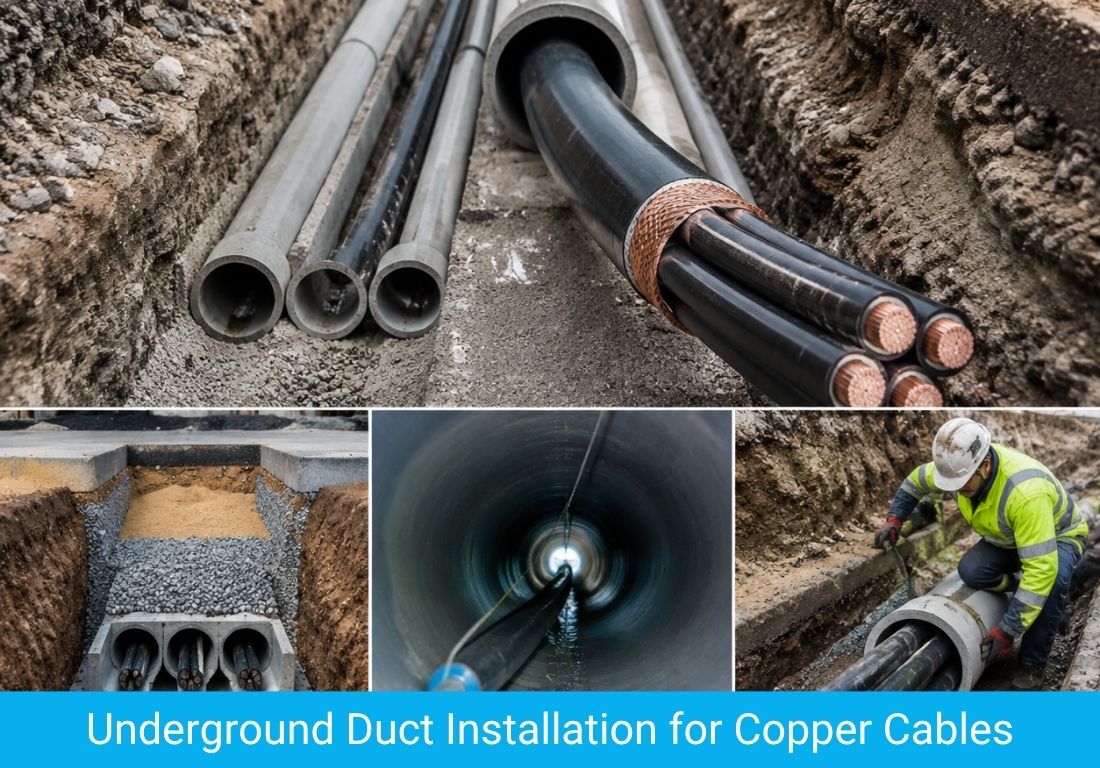
Duct installation – routing copper armoured cables through pre-installed HDPE or RCC ducts/conduits in the trench – is the preferred method for main distribution routes, road crossings, and installations where the cable may need to be replaced or additional cables pulled in future without excavation.
Advantages of Duct Installation
- Cable replacement or additional cable installation possible without excavation – pulling new cables through existing ducts at end of cable life or for capacity additions
- Better mechanical protection from third-party excavation damage – the duct provides an additional layer of protection beyond the cable’s own steel wire armour
- Easier installation on long runs – cables can be pulled through lubricated ducts over longer distances with less surface damage risk than open trench pulling
- Multiple cables in separate ducts avoid the grouping derating that applies to cables laid in close proximity in a common trench
Duct Selection and Installation
HDPE conduits (typically 100 mm internal diameter for LT cables up to 150 sq mm) are the standard duct material for underground cable installations in India. Key requirements per IS 1255 and good practice include:
- Duct diameter should be at least 1.5 times the overall diameter of the cable being pulled through – to allow cable pulling without excessive friction
- Draw wires or pull tapes should be pre-installed in ducts at the time of duct laying, to facilitate future cable pulling
- Duct joints should be watertight – water ingress through duct joints can fill the duct, increasing pulling tension and potentially trapping moisture at the cable joint
- Spare ducts should be provided in all major cable routes for future capacity – typically 20% spare capacity as good practice for long-term infrastructure routes
- Duct entry and exit points at manholes and cable chambers should be sealed after cable installation to prevent water accumulation
Current Capacity Derating for Duct Installation
Copper armoured cables installed in ducts have lower current-carrying capacity than the same cables directly buried, because the air gap between cable and duct reduces the thermal conductivity of the installation. Current capacity derating factors for duct-installed cables must be applied from the IS 1554 or IS 7098 installation method tables. This is one reason why XLPE copper armoured cables are particularly advantageous for duct installations – their higher base temperature rating provides more headroom against the duct installation derating.
Underground Installation Method 3: Open Trench - Tray or Cleated Installation
In some industrial and infrastructure applications – particularly within factory compounds, power plant cable basements, and service tunnels – copper armoured cables are routed in open trenches on cable trays or cleated directly to the trench walls. This method is technically above-ground in terms of installation environment but is effectively underground in that the cables are below floor level and not directly accessible without excavation or trench cover removal.
This method provides the best thermal dissipation of the three methods (the cable is in air, not soil or duct), allowing the cable’s full rated current capacity to be used without burial or duct derating. It also allows direct visual inspection of the cable condition without excavation. IS 1557 (cable support systems) and IS 10810 (cable test methods) provide guidance for tray-installed cables.
Testimonials
“Procured 4-core 25 sq.mm copper armoured cable for a manufacturing plant’s underground main line. The galvanized steel wire armouring is rigid and gave zero issues during heavy trench pulling. Insulation resistance (megger test) values were consistent across the 200-meter run. Excellent current-carrying capacity with minimal voltage drop.”
– Rajesh Patel
Selecting the Right Copper Armoured Cable for Underground Installation
PVC vs XLPE for Underground
For underground installations in India’s variable climate – particularly in Delhi NCR where summer ambient soil temperatures at shallow depths can be elevated – XLPE-insulated copper armoured cables from Polycab, Havells or KEI are strongly preferred over PVC. XLPE’s 90°C maximum conductor temperature versus PVC’s 70°C means XLPE cables carry higher current at the same conductor size, resist elevated soil temperature conditions better, and offer superior long-term ageing resistance in the underground environment. Capital Cables recommends XLPE copper armoured cables for all new underground feeder installations.
SWA vs STA for Underground
Steel Wire Armour (SWA) is the correct choice for all multicore copper armoured cables installed underground – direct burial, duct, or trench. SWA provides the strongest mechanical protection against soil settlement, ground movement, and rodent attack. STA (Steel Tape Armour) is used on single-core cables to avoid the eddy current losses that SWA would introduce on single-core cables carrying large alternating currents.
Our Other Products
Computer CablesNumber of Cores for Underground Three-Phase Distribution
For three-phase LT underground distribution in India, 3.5-core copper armoured cables (3 full-size phase conductors plus one half-size neutral conductor) or 4-core cables (3 full-size phase conductors plus one full-size neutral) are standard. 3.5-core is economically efficient for balanced three-phase loads where the neutral carries only residual imbalance current. 4-core is appropriate where neutral current is significant – in systems with substantial single-phase loads that create neutral current close to phase current levels.
IS Standards and Compliance for Underground Copper Armoured Cable Installation
- IS 1255: Code of Practice for Installation and Maintenance of Power Cables – the primary Indian Standard governing all aspects of underground cable installation including burial depth, bedding, protection, and route marking
- IS 1554 (Part 1): PVC-insulated and PVC-sheathed heavy-duty electric cables – the IS standard for PVC copper armoured cables used in underground LT distribution
- IS 7098 (Part 1): Cross-linked polyethylene insulated PVC sheathed cables – the IS standard for XLPE copper armoured cables preferred for underground installation
- IS 3975: Mild steel wires, strips and tapes for armouring cables – the IS standard governing armour construction quality in copper armoured cables
- IS 8130: Conductors for insulated electric cables and flexible cords – the IS standard for copper conductor quality
Capital Cables supplies copper armoured cables from Polycab, Havells and KEI that carry BIS certification confirming compliance with all applicable IS standards. Every cable supplied by Capital Cables is embossed with the relevant IS standard number, manufacturer name, conductor size, voltage rating, and BIS licence number – enabling project engineers to verify IS compliance on delivery.
Capital Cables: Your Underground Cable Supply Partner in Delhi and NCR
Capital Cables has extensive experience supplying copper armoured industrial cables for underground distribution projects across Delhi, NCR and North India – from residential township feeders and commercial building sub-mains to industrial compound distribution and infrastructure projects. Our supply capability includes:
- Complete inventory of Polycab wire dealers stock, Havells Distributor in DELHI NCR offerings, and KEI Distributor Delhi copper armoured cables in SWA and STA, PVC and XLPE, across all standard sizes for LT underground installation
- Technical consultation on cable type selection, size verification and IS 1255 compliance requirements for your specific underground installation
- Supply of accessories: cable joint kits, termination kits, cable route marker tiles, and HDPE duct systems for complete underground cable infrastructure supply
- Logistics support for delivery of drum quantities to project sites in Delhi and NCR
- Documentation support: IS test certificates, manufacturer quality certificates, BIS licence copies for project documentation requirements
Table of Contents