

Table of Contents
Introduction: Why Getting the Cable Size Right Matters More Than Getting the Brand Right
Electrical contractors, project engineers and procurement managers across India share a common challenge: selecting the correct copper armoured cable size for a given load, distance and installation environment. Purchase the wrong size – even a premium Polycab, Havells or KEI copper armoured cable – and you face one of two equally damaging outcomes. Undersize the cable and it runs hot, accelerates insulation degradation and eventually becomes a fire risk. Oversize it and you waste capital on unnecessary conductor cross-section, raising project costs without any performance benefit.
The correct copper armoured cable size is not determined by guesswork, experience alone, or the installer’s habit of always choosing the ‘next size up’. It is determined by a structured technical assessment of four parameters: the current-carrying capacity required, the voltage drop acceptable over the cable length, the installation method and ambient conditions, and the compliance requirements of the relevant Indian Standard. This guide takes you through each of these parameters with practical clarity, so you can specify the right copper armoured cable size with confidence – whether you are sourcing Polycab copper armoured cables, Havells LT armoured cables or KEI copper power cables from Capital Cables.
Capital Cables (India) Pvt. Ltd. is an authorised dealer, distributor and supplier of copper armoured cables from Polycab, Havells and KEI – three of India’s most trusted cable manufacturers. With an extensive inventory across all standard sizes from 1.5 sq mm to 300 sq mm and a technical team available for specification support, Capital Cables is the preferred sourcing partner for electrical contractors and project engineers across Delhi and North India.
Understanding Copper Armoured Cable Construction: What Makes a Size a 'Size'
Before selecting a copper armoured cable size, it helps to understand what the ‘sq mm’ rating actually refers to. The sq mm (square millimetre) designation indicates the cross-sectional area of the copper conductor within the cable – not the overall cable diameter. A 16 sq mm copper armoured cable, for example, has a copper conductor with a cross-sectional area of 16 sq mm. The overall cable diameter will be substantially larger due to the insulation, bedding, steel wire armour (SWA) or steel tape armour (STA) layer, and outer PVC sheath.
The standard construction of a copper armoured cable as per IS 1554 (Part 1) for PVC-insulated or IS 7098 (Part 1) for XLPE-insulated cables consists of:
- Copper conductor: plain or stranded annealed copper, available in Class 1 (solid) and Class 2 (stranded) as per IS 8130
- PVC insulation (IS 1554) or XLPE insulation (IS 7098): XLPE-insulated cables operate at higher conductor temperatures (90°C vs 70°C for PVC), giving higher current ratings at the same conductor size
- Inner bedding or filling: PVC compound to maintain circular form
- Steel Wire Armour (SWA) or Steel Tape Armour (STA): galvanised steel wires or tapes providing mechanical protection against impact, crushing and rodent attack
- Outer PVC sheath: black or red PVC providing environmental protection
This construction is available in single-core, 2-core, 3-core, 3.5-core and 4-core configurations. The number of cores affects the overall cable size at the same conductor cross-section, and the appropriate multicore configuration depends on the power distribution system (single-phase, three-phase with or without neutral).
Standard Copper Armoured Cable Sizes Available in India
Indian cable manufacturers Polycab, Havells and KEI manufacture copper armoured cables across a standard range of conductor sizes. Capital Cables stocks and supplies the full range, from light-duty residential sizes to heavy industrial conductor cross-sections:
| Conductor Size (sq mm) | Typical Application | Phase Configuration | IS Standard |
| 1.5 sq mm | Light domestic sub-circuits, control wiring | Single/Multi-core | IS 1554 / IS 7098 |
| 2.5 sq mm | Residential power points, small commercial | Single/Multi-core | IS 1554 / IS 7098 |
| 4 sq mm | Residential mains, small sub-distribution boards | Single/Multi-core | IS 1554 / IS 7098 |
| 6 sq mm | Commercial building sub-mains, light industrial | Multi-core | IS 1554 / IS 7098 |
| 10 sq mm | Light industrial feeders, LT panel sub-circuits | Multi-core | IS 1554 / IS 7098 |
| 16 sq mm | Industrial machinery feeders, medium commercial | Multi-core | IS 1554 / IS 7098 |
| 25 sq mm | Medium industrial power distribution | Multi-core | IS 1554 / IS 7098 |
| 35 sq mm | Industrial sub-mains, pump feeder cables | Multi-core | IS 1554 / IS 7098 |
| 50 sq mm | Heavy industrial, MV sub-station secondary | Multi-core | IS 1554 / IS 7098 |
| 70 sq mm | Large motor feeders, factory main incomer | Multi-core | IS 1554 / IS 7098 |
| 95 sq mm | HT/LT substation feeders, infrastructure projects | Multi-core | IS 1554 / IS 7098 |
| 120 sq mm | Main incomer cables, data centre power | Multi-core | IS 1554 / IS 7098 |
| 150 sq mm | Power station auxiliary, large infrastructure | Multi-core | IS 1554 / IS 7098 |
| 185 sq mm | Utility distribution, transformer secondaries | Multi-core | IS 1554 / IS 7098 |
| 240 sq mm | High-load industrial main incomers | Multi-core | IS 1554 / IS 7098 |
| 300 sq mm | Maximum LT cross-section, utility feeders | Multi-core | IS 1554 / IS 7098 |
For supply of any size from this range – whether Polycab copper armoured cable, Havells LT armoured cable or KEI power cable – contact Capital Cables for current availability and technical consultation.
Read Our Article
Copper Flexible Cables – Power Meets FlexibilityStep 1: Determine the Design Current (Full Load Current)
The starting point for copper armoured cable size selection is calculating the full load current the cable must carry. For motor-driven loads, this is the motor’s full load current (FLC) as given by the motor name plate or IS 325. For distribution circuits, it is the sum of all connected load currents with an appropriate demand factor applied.
Single-Phase Loads
Full Load Current (A) = Load Power (W) ÷ (Supply Voltage (V) × Power Factor)
Example: A 5 kW single-phase load at 230V with 0.85 power factor draws approximately 25.6 A. Select a cable with a current rating above 25.6 A at the expected installation conditions.
Three-Phase Loads
Full Load Current (A) = Load Power (W) ÷ (1.732 × Line Voltage (V) × Power Factor × Efficiency)
Example: A 22 kW three-phase motor at 415V, 0.85 pf, 0.92 efficiency draws approximately 40 A. Select a cable rated above 40 A at the installation derating conditions.
Step 2: Apply Derating Factors for Installation Conditions
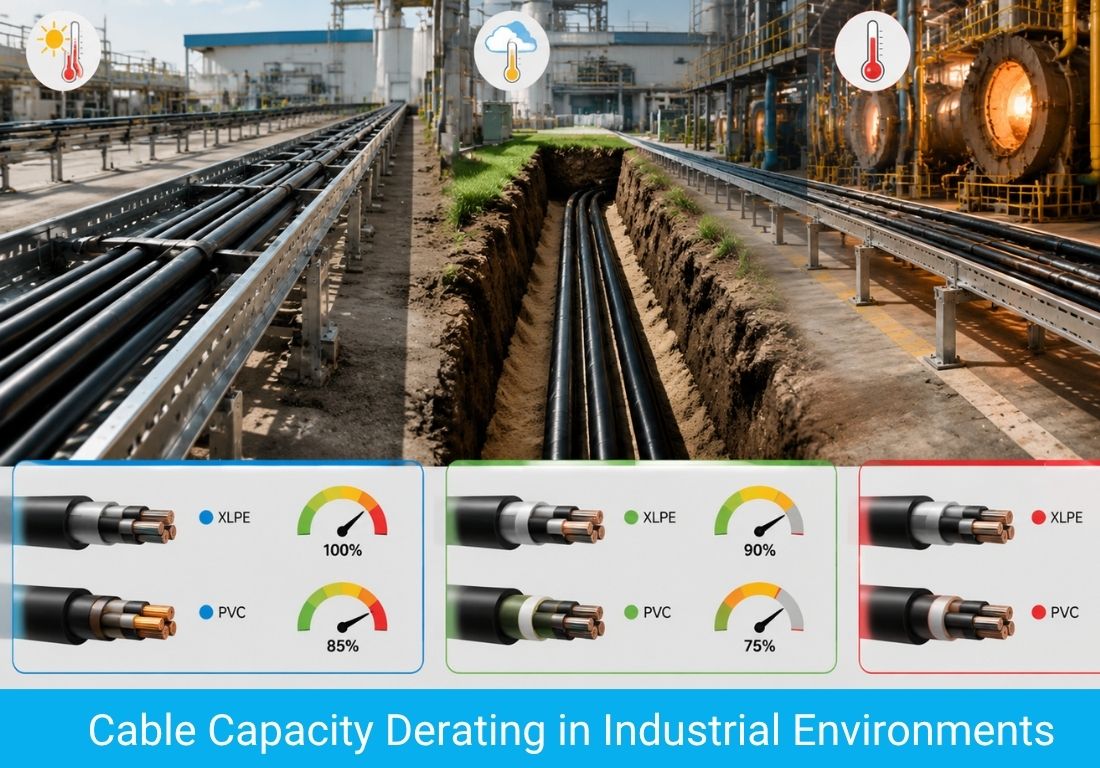
A cable’s published current rating in IS 1554 or IS 7098 is for a specific reference installation condition: typically single cables in free air at 40°C ambient, or cables directly buried in ground at 30°C. Real installations deviate from these conditions – and each deviation reduces the cable’s ability to safely carry its rated current. These reductions are applied through derating factors.
Ambient Temperature Derating
If the ambient temperature in the installation environment exceeds the reference temperature (40°C for air installations, 30°C for ground), the cable’s current capacity is reduced. In industrial environments – near furnaces, boiler rooms, engine rooms – this can be a significant derating. XLPE-insulated cables have a higher reference temperature and are therefore less affected by high ambient conditions than PVC-insulated cables of the same size.
Grouping Factor Derating
When multiple cables are run in the same tray, duct, conduit or trench, each cable’s heat cannot dissipate as freely as a single isolated cable. The more cables grouped together, the lower the current each can carry. IS 1554 grouping factors can reduce effective current capacity significantly – making it essential to account for all adjacent cables when sizing a new cable in an existing installation.
Thermal Resistivity of Ground (Buried Cables)
For directly buried copper armoured cables, the thermal resistivity of the soil affects how quickly heat generated by the cable dissipates. Dry, sandy or rocky soil has higher thermal resistivity than moist clay – meaning cables in dry soil run hotter and must be derated more heavily than cables in moist conditions. The IS 1255 standard for cable installation provides guidance on soil thermal resistivity factors.
Depth of Burial
Cables buried deeper than the standard reference depth (typically 0.8 m) have reduced thermal dissipation and must be derated accordingly. However, deeper burial is often required for mechanical protection – making XLPE-insulated armoured cables the preferred choice since their higher temperature rating provides some buffer against burial depth derating.
Testimonials
Guys it’s really good quality of cables…..
I am also using. So why are you wating
Order Now………
Step 3: Calculate Voltage Drop to Confirm Adequacy
Even after confirming that the chosen cable size passes the current-carrying capacity check, it must also pass a voltage drop check. Over long cable runs – common in industrial factories, large buildings and underground distribution – the resistance of the copper conductor causes a voltage drop that can affect equipment performance at the load end.
IS 732 and good engineering practice typically limit voltage drop to 2.5% for lighting circuits and 5% for power circuits under Indian distribution conditions. For critical loads – medical equipment, data centre UPS, precision machinery – tighter limits may apply.
Voltage Drop Calculation
Voltage Drop (V) = Current (A) × Cable Length (m) × Resistance per metre (Ω/m) × 2 (for single-phase) or × √3 (for three-phase)
The resistance per metre at operating temperature is available from Polycab, Havells and KEI cable datasheets and the IS 8130 conductor resistance tables. Capital Cables can provide the relevant cable datasheet for any size and brand on request.
When Voltage Drop Governs Size Selection
For long cable runs – underground feeders to outlying distribution boards, sub-station to factory building runs over 100 metres, solar farm DC cable runs – voltage drop often governs the cable size selection rather than current-carrying capacity. In these cases, you may need to select one or two sizes larger than the current-carrying capacity calculation would indicate, to keep voltage drop within acceptable limits.
Our Other Products
Power & Control CablesStep 4: Match to the Correct Copper Armoured Cable Type
Once the conductor cross-section is determined, the final step is selecting the correct cable type for the installation environment. The choice between PVC-insulated (IS 1554) and XLPE-insulated (IS 7098) copper armoured cables, and between SWA and STA armouring, depends on the installation conditions.
PVC vs XLPE Insulation
PVC-insulated copper armoured cable (IS 1554): Maximum conductor temperature 70°C. Lower current ratings at the same conductor size. Lower material cost. Suitable for most standard LT distribution installations where operating temperatures are moderate. Polycab, Havells and KEI all manufacture IS 1554-compliant PVC armoured cables in the full size range.
XLPE-insulated copper armoured cable (IS 7098): Maximum conductor temperature 90°C. Higher current ratings – meaning you can often select one size smaller than PVC for the same load, reducing cable costs over long runs. Better performance in high ambient temperature environments. Preferred for industrial, underground and infrastructure applications. The premium choice across all three brands.
SWA vs STA Armouring
Steel Wire Armour (SWA): Round galvanised steel wires wound helically around the cable. Provides the strongest mechanical protection. The preferred choice for direct burial, duct installation and any installation where mechanical impact risk is significant. Standard for multicore cables above 25 sq mm.
Steel Tape Armour (STA): Flat steel tapes applied in a counter-helical pattern. Used primarily on single-core cables where SWA would create eddy current losses. Less mechanical protection than SWA but suitable for single-phase applications and protected indoor installations.
Quick Size Selection Reference by Application
The following guidance is based on typical IS 1554 PVC armoured copper cable ratings for standard installation conditions. Always verify against actual derating calculations for your specific installation.
| Application | Typical Load Range | Starting Size (Guidance) | Notes |
| Residential apartment main incomer | Up to 60A | 16 sq mm 4-core | Verify voltage drop for runs >30m |
| Commercial office building feeder | 60A–100A | 25–35 sq mm 3.5-core | XLPE preferred for long risers |
| Small industrial machinery | Up to 40A | 16 sq mm 4-core | Check grouping if multiple cables |
| Medium industrial motors (15–22 kW) | 40A–60A | 25–35 sq mm 4-core | SWA for factory floor routing |
| Large industrial motors (30–55 kW) | 60A–100A | 35–70 sq mm 4-core | XLPE for high ambient areas |
| Factory main incomer (100–200A) | 100A–200A | 70–120 sq mm 4-core | Voltage drop critical for long runs |
| Underground distribution feeder | Varies | 35 sq mm minimum | Burial depth and soil type govern |
| Solar PV DC feeder cable | Varies by array | 16–50 sq mm | Single-core STA, XLPE insulation |
| LT substation secondary feeder | 200A–400A | 150–240 sq mm | 3.5-core XLPE SWA standard |
| Data centre PDU feeder | 100A–200A | 70–120 sq mm | XLPE, redundant path calculation |
Important: The above table provides starting guidance only. Always perform site-specific calculations for current carrying capacity, voltage drop and derating before finalising cable size.
How Capital Cables Helps You Get the Size Right
Capital Cables is not merely a cable supplier – it is a technical partner for electrical contractors, project engineers and procurement managers across Delhi and North India. As an authorised dealer, distributor and supplier of copper armoured cables from Polycab, Havells and KEI, Capital Cables provides:
- Complete inventory across all standard copper armoured cable sizes from 1.5 sq mm to 300 sq mm in PVC and XLPE, SWA and STA variants
- Technical datasheets from Polycab, Havells and KEI providing conductor resistance, current ratings, voltage drop constants and dimensional data for every cable size
- Pre-purchase technical consultation to help contractors and project engineers verify their size calculations and select the optimal cable type for their application
- IS 1554, IS 7098 and BIS-certified cables only – ensuring every cable supplied meets the relevant Indian Standard and carries the correct ISI marking
- Competitive pricing on bulk project quantities with reliable delivery timelines across Delhi, NCR and North India
- After-supply support including availability of additional quantities for project extensions and replacements
📞 Call: Get in touch with Capital Cables for size consultation and supply
🌐 Website: capitalcables.co.in
Conclusion: The Right Size is the Right Investment
Selecting the correct copper armoured cable size is one of the most consequential decisions in any electrical installation project. It determines the safety of the installation for its entire operational life, the quality of power supply at the load, and the efficiency of capital expenditure. A correctly sized Polycab, Havells or KEI copper armoured cable – sourced from Capital Cables with IS-certified quality assurance – is an investment that performs reliably for 25 to 30 years without intervention.
Take the time to calculate correctly. Apply the derating factors that reflect your actual installation conditions. Check voltage drop for every long cable run. And when in doubt, consult the technical team at Capital Cables before placing your order – it is far less expensive to get the specification right before cutting the cable than to discover a sizing error after installation.
Table of Contents