

Table of Contents
Hospitals and healthcare facilities are among the most demanding environments for electrical infrastructure. A power interruption lasting even a few seconds in an intensive care unit, operating theatre, or MRI suite can have life-threatening consequences. The choice of wiring and cabling is therefore not merely a technical decision — it is a patient safety decision. Copper armoured cable plays a critical role in ensuring that critical electrical circuits in healthcare premises remain reliable, protected, and compliant with applicable standards.
Why Healthcare Electrical Infrastructure Demands More
Unlike commercial buildings or factories, hospitals operate 24 hours a day, 365 days a year with zero tolerance for electrical failure. The National Building Code of India (NBC) and IS 732 require hospitals to maintain two independent power sources — the utility grid and a standby generator — with automatic changeover. Both feeds require cabling that can withstand mechanical damage, moisture ingress, and the demands of continuous high-load operation.
Additionally, hospitals contain high-value medical equipment — ventilators, dialysis machines, infusion pumps, digital imaging systems — that is sensitive to voltage fluctuations caused by poor cable sizing or deteriorating insulation. Copper armoured cable, with its superior conductivity and mechanical robustness, is the preferred choice for critical circuit feeders in hospital electrical design.
Copper vs. Aluminium: Why Healthcare Specifies Copper
While aluminium armoured cables are cost-effective for large industrial feeder applications, healthcare electrical engineers overwhelmingly specify copper conductors for critical and life-safety circuits. The reasons are:
- Higher Conductivity: Copper’s electrical conductivity is approximately 60% higher than aluminium’s, allowing smaller conductor cross-sections for the same current-carrying capacity — important in congested cable routes inside hospital walls and ceiling voids.
- Superior Mechanical Properties: Copper conductors are more flexible and less prone to breakage at terminations — a crucial factor during the frequent maintenance and system modifications that occur throughout a hospital’s operational life.
- Reliable Terminations: Copper forms stable, low-resistance connections at termination points. Aluminium oxidises and requires special bi-metal lugs to prevent connection failure, which is unacceptable in life-critical circuits.
- Fault Withstand: High-conductivity copper conductor cables (often denoted as PVC insulated copper conductor cable) offer excellent short-circuit current withstand capability, important in hospital LV switchboards fed by large transformers.
Applicable Standards for Hospital Cable Installations in India
Healthcare electrical installations must comply with a range of national and international standards:
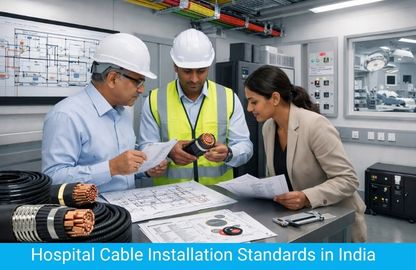
- IS 1554 Part 1: PVC insulated cables for working voltages up to and including 1100V
- IS 7098 Part 1: Cross-linked polyethylene (XLPE) insulated cables for voltages up to 1.1 kV
- NBC 2016 Part 8: Electrical and allied installations — includes specific provisions for hospitals
- IS 732: Code of practice for electrical wiring installations
- IEC 60364-7-710: Electrical installations of buildings — requirements for special installations — medical locations
- NABH Standards: National Accreditation Board for Hospitals standards include electrical safety requirements
Copper armoured cables supplied to hospital projects must carry BIS certification (ISI mark) confirming compliance with the relevant IS standard. Capital Cables supplies only BIS-certified cables from tier-1 brands including Polycab, Havells, and KEI.
Cable Types for Different Hospital Circuit Categories
Hospitals classify electrical circuits into three categories under IEC 60364-7-710, each with distinct cable requirements:
Group 0 — Areas without deliberate application of current-carrying parts: General purpose areas such as administrative offices, corridors, cafeterias. Standard FR or FRLS PVC-insulated copper cables are acceptable.
Group 1 — Areas where medical electrical equipment may be used: Patient wards, recovery rooms, examination rooms. FRLS (Flame Retardant Low Smoke) or LSZH (Low Smoke Zero Halogen) copper cables are preferred because in a fire, conventional PVC produces dense toxic smoke that impedes evacuation.
Group 2 — Areas where discontinuity of supply can be life-threatening: Operating theatres, ICUs, CCUs, cardiac catheterisation labs. These circuits require fire survival cables — copper conductors capable of maintaining circuit integrity at 830°C for 3 hours as per BS 6387 Category CWZ.
- Fire survival copper cables must be specified for all Group 2 circuits
- All hospital MV/LV feeder cables should be copper armoured cable with XLPE insulation
- Sub-distribution boards on each floor should be fed by copper armoured cable from the main LT switchboard
- UPS and generator circuits must use copper cables to ensure low impedance and reliable relay operation
Cable Routing and Protection in Healthcare Buildings
IS 732 and NBC 2016 specify that cables in hospital buildings should be routed away from areas where mechanical damage is likely. For cables running through plant rooms, basements, service tunnels, and cable risers, copper armoured cable provides the required mechanical protection without needing additional conduit in most cases.
Key routing guidelines:
- Maintain minimum 300 mm separation between power and medical signal cables to prevent electromagnetic interference (EMI) with patient monitoring equipment
- Use dedicated fire-rated cable trays for Group 2 fire survival cables, segregated from standard power cables
- All underground cable runs within hospital campuses should use direct-burial rated copper armoured cable
- Avoid routing critical circuit cables through areas with high fire load (kitchens, boiler rooms, laundry)
- Document all cable routes on as-built drawings — essential for NABH accreditation audits
Our Other Product
Special CablesTestimonials
“good”
Earthing and Equipotential Bonding Requirements
Medical electrical equipment is extremely sensitive to earth potential differences. IEC 60364-7-710 requires supplementary equipotential bonding in Group 1 and Group 2 medical locations — all conductive parts within the patient environment must be bonded to a local equipotential bonding bar using copper conductors.
The armour of copper armoured cables provides an additional earth path and mechanical protection but must be properly terminated at both ends using appropriate cable glands. Capital Cables advises contractors to use brass earthing glands for all copper armoured cable terminations in hospital projects to ensure consistent earth continuity.
How Capital Cables Supports Healthcare Projects
Capital Cables (I) Pvt. Ltd. has supplied wires and cables to hospitals, diagnostic centres, pharmaceutical plants, and medical colleges across Delhi-NCR. Their product range includes copper armoured cables, FRLS house wires, fire survival cables, and instrumentation cables from Polycab, Havells, and KEI — all with BIS certification and manufacturer warranties.
For large hospital projects, Capital Cables offers project-specific pricing, bulk supply commitments, and delivery scheduling to match the construction programme. Their technical team can review cable schedules, verify specifications against IS standards, and advise on the most cost-effective cable selection for each circuit category.
Read Our Article
Why Havells Wires and Cables for Delhi Projects?Conclusion
Copper armoured cable is the foundation of reliable, safe electrical infrastructure in hospitals and healthcare facilities. From high-conductivity copper conductor cables for patient ward feeders to fire survival cables for operating theatre circuits, each specification decision affects patient safety and regulatory compliance. Sourcing from an authorised distributor like Capital Cables (I) Pvt. Ltd. ensures that every cable delivered to your project is genuine, certified, and fit for the demanding requirements of healthcare electrical installations.
Table of Contents