

Table of Contents
Selecting the correct cable size is one of the most critical decisions an electrical engineer or contractor makes. An undersized cable causes overheating, voltage drops, and premature insulation failure; an oversized one wastes capital. For industrial installations — factories, substations, water treatment plants, and infrastructure projects — aluminium armoured cables are the workhorse of power distribution. Yet many procurement teams still rely on thumb-rules or outdated tables instead of a proper load calculation. This guide explains the systematic methodology.
Why Aluminium Armoured Cable Dominates Industrial Power Distribution
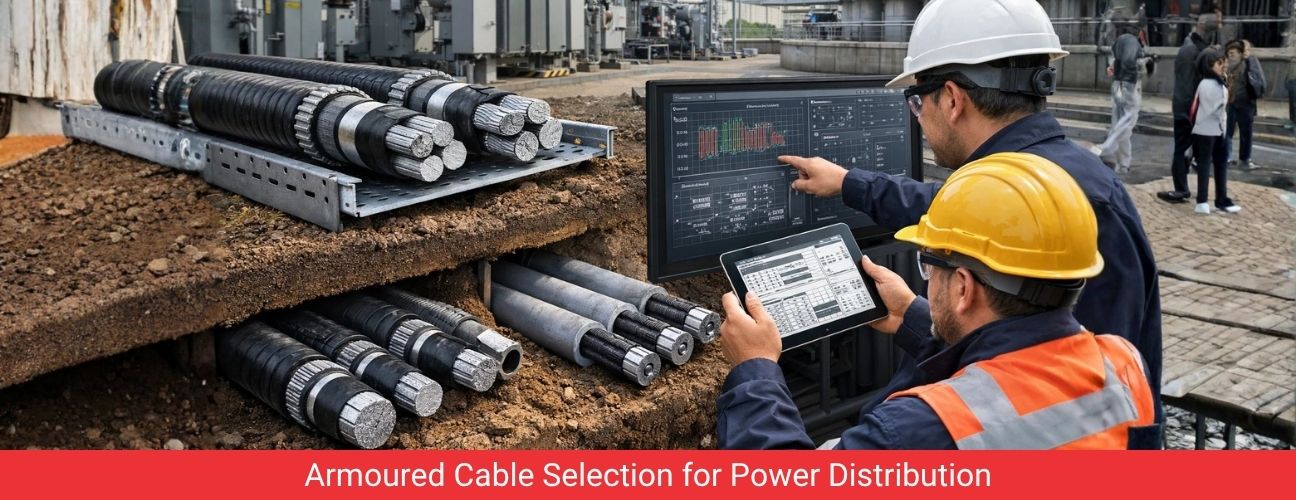
Aluminium armoured cable, often abbreviated as Al armoured cable or simply armoured cable, offers an excellent balance of conductivity, mechanical protection, and cost. The steel wire armour (SWA) protects the core conductors against physical damage, rodents, and moisture, making it ideal for direct burial, cable trays, and conduit runs in harsh environments.
Compared to copper, aluminium conductors are approximately 50–60% lighter and significantly cheaper, which matters enormously on long runs inside manufacturing plants or across industrial campuses. Polycab, Havells, KEI, and other leading brands manufacture a wide range of 1.1KV aluminium armoured power cables meeting IS 1554 (Part 1) standards.
 Drop Us an Email!
Step 1 — Determine the Connected Load (kVA or kW)
The starting point is always the total connected load at the receiving end. Sum up all loads — motors, lighting panels, HVAC units, welding machines, process equipment — and convert to kVA using the power factor of the installation (typically 0.8 to 0.9 for industrial premises).
Formula: kVA = kW ÷ Power Factor
Then convert to full-load current (FLA):
For three-phase supply: I (Amps) = kVA × 1000 ÷ (√3 × Voltage)
For a 415V, three-phase, 100 kVA load with PF 0.85: I = 100,000 ÷ (1.732 × 415) = 139 A
Step 2 — Apply Derating Factors
The current-carrying capacity (ampacity) published in manufacturer catalogues assumes specific ambient and installation conditions. Real-world installations almost always require derating:
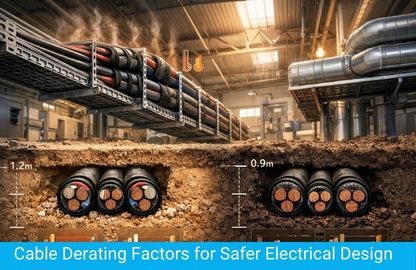
- Ambient Temperature Derating: Standard ratings assume 30°C ambient. In Indian summers, cable trays inside factory roofs can see 45–50°C. Apply the temperature correction factor from IS tables — typically 0.87 at 45°C for PVC insulated cables.
- Grouping Factor: When multiple cables share the same tray or duct, mutual heating reduces capacity. For 4 cables touching each other, apply a grouping factor of 0.65–0.70.
- Soil Thermal Resistivity (for buried cables): Sandy, well-drained soil allows better heat dissipation than waterlogged clay. The standard reference soil resistivity is 1.5 K·m/W.
- Depth of Burial: Deeper burial (>0.9 m) requires an additional derating of 0.96–0.99 depending on depth.
Effective ampacity = Rated ampacity × Temperature factor × Grouping factor × Installation factor
Read Our Article
Different Core Aluminum Armoured Cables – An OverviewStep 3 — Check Voltage Drop
IS 732 specifies that voltage drop from the main switch to any load point should not exceed 5% for industrial installations. For long cable runs in large industrial plants, voltage drop is often the governing criterion rather than thermal ampacity.
Voltage Drop (%) = (√3 × I × L × (R cosφ + X sinφ)) ÷ (10 × V)
Where L = cable length (metres), R = conductor resistance (Ω/km), X = reactance (Ω/km), V = line voltage (V).
If the voltage drop exceeds 5%, you must increase the conductor cross-section (CSA) even if the thermal capacity was adequate at a smaller size. This is a common sizing error on 200–400 metre feeder runs.
Step 4 — Verify Short Circuit (Fault Current) Rating
Industrial installations connected to large MV/LV transformers can experience high fault currents — sometimes 15–30 kA at 415V. The cable’s conductors must be capable of withstanding this current for the time it takes the protection relay or fuse to clear the fault (typically 0.1–1 second).
Minimum CSA for fault current (adiabatic equation): A = (I_fault × √t) ÷ K
Where K = 94 for PVC-insulated aluminium (from IS 3961). If the calculated minimum CSA for fault current exceeds your thermally or voltage-drop-derived size, the fault current value governs.
Testimonials
Guys it’s really good quality of cables…..
I am also using. So why are you wating🧐
Order Now………
Conductor Size Selection Guide (Reference Table)
Below is a quick-reference sizing guide for 1.1 kV XLPE-insulated aluminium armoured cable on surface-mounted cable tray in 40°C ambient:
- 16 sq mm — up to 75A (~43 kVA at 415V)
- 25 sq mm — up to 95A (~56 kVA)
- 35 sq mm — up to 115A (~68 kVA)
- 50 sq mm — up to 140A (~83 kVA)
- 70 sq mm — up to 175A (~103 kVA)
- 95 sq mm — up to 210A (~123 kVA)
- 120 sq mm — up to 240A (~141 kVA)
- 150 sq mm — up to 270A (~158 kVA)
- 185 sq mm — up to 305A (~178 kVA)
- 240 sq mm — up to 360A (~210 kVA)
- 300 sq mm — up to 415A (~242 kVA)
Note: Always verify against manufacturer data sheets and apply site-specific derating factors. The above values are indicative only.
Our Other Products
Instrument Signal CablesCommon Mistakes in Aluminium Armoured Cable Sizing
- Ignoring derating for grouped cables — the most frequent error on industrial tray runs
- Using copper cable ampacity tables for aluminium conductors (aluminium carries ~75% of copper’s current for the same CSA)
- Not accounting for future load growth — always add 20–25% design margin
- Forgetting that 3.5-core and 4-core cables have different ampacity than 3-core due to the neutral conductor
- Selecting cable by price per metre without considering the total lifecycle cost of energy losses
How Capital Cables Helps Industrial Buyers Get Sizing Right
Capital Cables (I) Pvt. Ltd. is one of Delhi-NCR’s most trusted authorised distributors for Polycab, Havells, and KEI wires and cables. The company supplies a comprehensive range of aluminium armoured cables — 1.1 kV, 3.5 core, 4 core, single core, and multi-core configurations — across sizes from 16 sq mm to 630 sq mm.
What sets Capital Cables apart is technical support. Our team of qualified electrical engineers helps project managers, contractors, and procurement teams verify cable selection, review load calculations, and source the exact specification required. Whether you need Polycab’s XLPE aluminium armoured cable for a Delhi Smart City project or KEI armoured cables for an industrial plant in Noida or Gurugram, Capital Cables maintains ready stock and offers competitive pricing.
Conclusion
Proper aluminium armoured cable sizing is a multi-step engineering process — not a catalogue lookup. Load calculation, derating, voltage drop verification, and fault current checking must all be completed before specifying a cable size. When in doubt, always consult a qualified electrical engineer and source from a reliable authorised dealer who can provide certified, genuine cables with manufacturer warranties. Capital Cables (I) Pvt. Ltd. is your dependable partner for high-quality armoured cables and technical guidance across Delhi, Noida, Gurugram, and beyond.
Table of Contents